

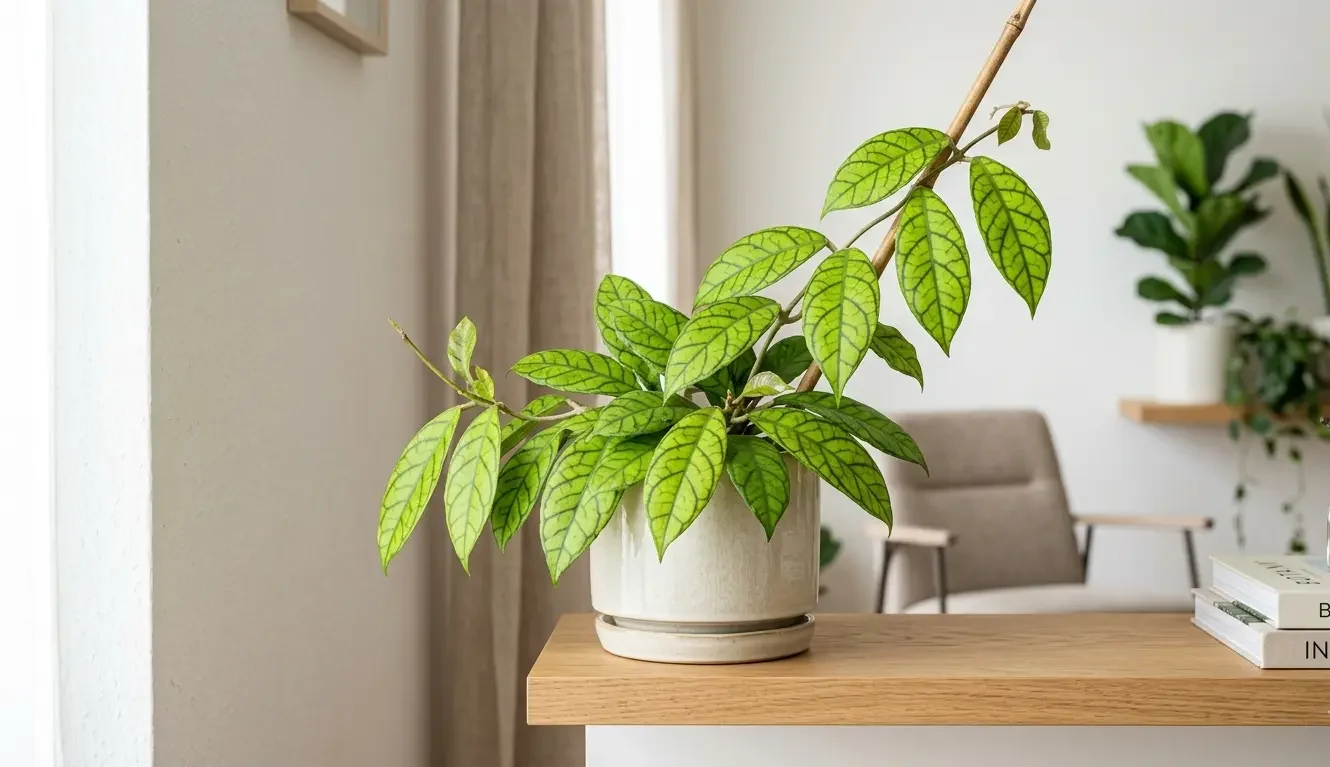
Hoya callistophylla is one of the most striking wax plants you can grow, prized for its large, stiff, leathery leaves laced with bold dark veins that look almost hand-painted. It has a reputation as a collector’s plant, but callistophylla care is genuinely straightforward, bright indirect light, an airy mix, a pole to climb, and watering only when the soil dries. The dramatic veined foliage gives a big visual payoff for very little fuss.
Short answer
Give a Hoya callistophylla bright indirect light to keep its dark veining sharp, water only when the top inch or two of soil dries, use a very airy fast-draining mix, and give it a moss pole to climb. Its stiff leaves cannot wrinkle when thirsty, so always check the soil rather than the leaves before watering.
This guide covers light, watering, soil, the famous veined leaves, climbing support, blooming, and the common problems. Callistophylla follows the same core rules as the rest of the genus, so if you want the wider picture, my Hoya care guide covers the basics that apply here too.
What is a Hoya callistophylla?
Hoya callistophylla is a species wax plant native to the rainforests of Malaysia and Borneo, where it grows as an epiphyte, climbing through trees. Its claim to fame is its foliage: large, stiff, leathery, lance-shaped leaves in lime to medium green, laced with prominent dark green veins that create a high-contrast, almost prehistoric look. The leaves commonly reach four to seven inches and feel surprisingly hard, almost like cardboard or plastic, which is one way to recognize the species.
A couple of naming notes that help at the plant shop: you may see callistophylla sold as Gunung Gading, which is simply the same plant named after the Malaysian location where it was found. It is also frequently confused with the similar dark-veined Hoya finlaysonii, whose veining is more splashed and erratic with wavier leaf margins, and with Hoya ellipitica, which has rounder, softer turtle-shell leaves. Callistophylla’s straighter-edged, stiff, boldly veined leaves are the giveaway.
Quick care summary
Here is the whole routine at a glance before the detail.
| Need | What the callistophylla wants |
|---|---|
| Light | Bright indirect light sharpens the veining |
| Water | When the top inch or two of soil is dry |
| Soil | Very airy, fast-draining, with bark and perlite |
| Humidity | Average to high, higher is appreciated |
| Temperature | 18 to 27 degrees Celsius, 65 to 80 Fahrenheit |
| Support | A moss pole, since it is a climber |
| Difficulty | Easy to moderate, looks fussier than it is |
| Toxicity | Generally considered non-toxic and pet-safe |
How much light does a Hoya callistophylla need?
Light is the most important factor for callistophylla, because it controls both growth and the all-important leaf contrast.
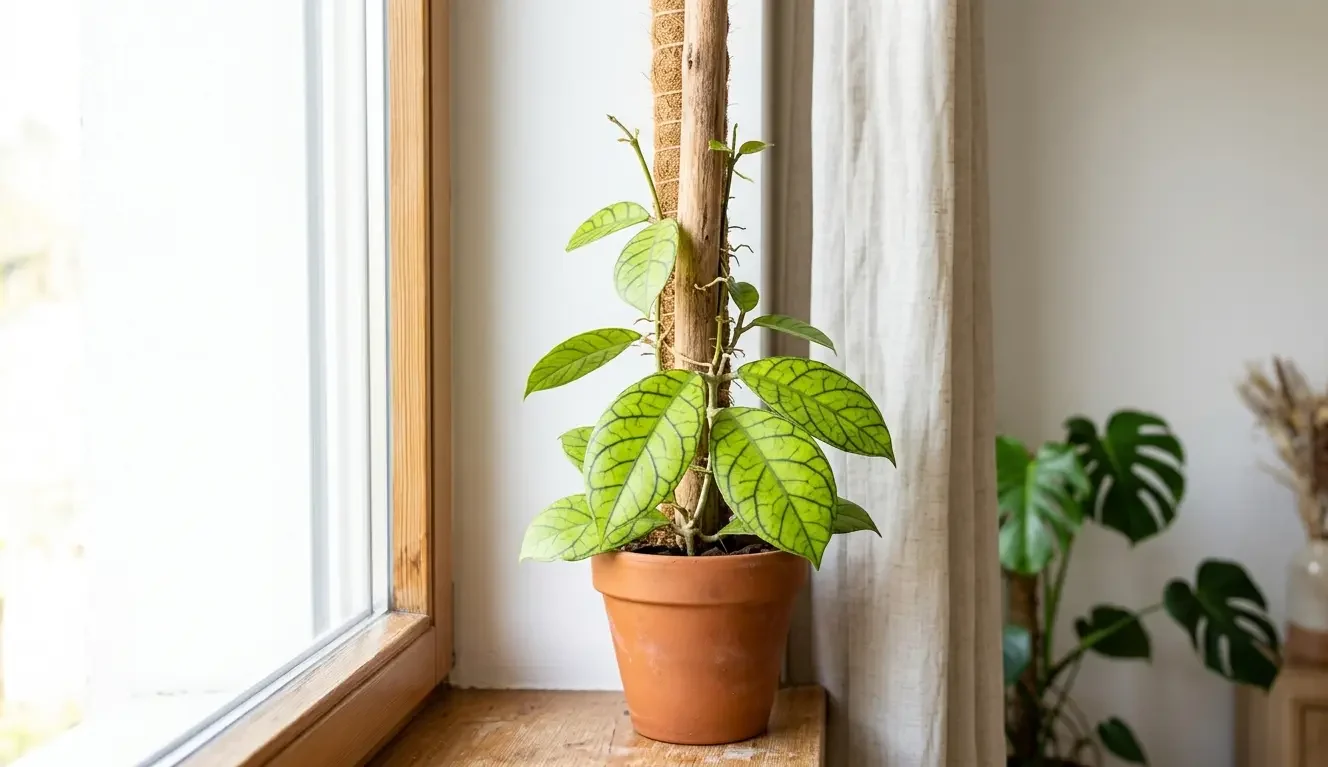
It wants bright indirect light. A spot near an east or west window is ideal; a brighter south or north window works with a sheer curtain to filter the strongest rays. The brighter the light, the sharper the contrast between the dark veins and the lighter green leaf, because strong light lightens the green background. In very high light or under strong grow lights, the leaves can even take on a reddish-bronze sun-stress tint that many collectors love. In low light, growth stops, new leaves come in small and dark with little of the distinctive veining, and the plant will not bloom. So give it the brightest indirect spot you can.
Sharper veins, more light
The dramatic vein contrast this plant is grown for is strongest in bright light. If your callistophylla’s leaves look flat and uniformly dark, it needs more bright indirect light.

How often should you water a Hoya callistophylla?
Like all Hoyas, callistophylla stores water in its thick leaves and is far more often killed by overwatering than by neglect, but it has one quirk that changes how you read it.
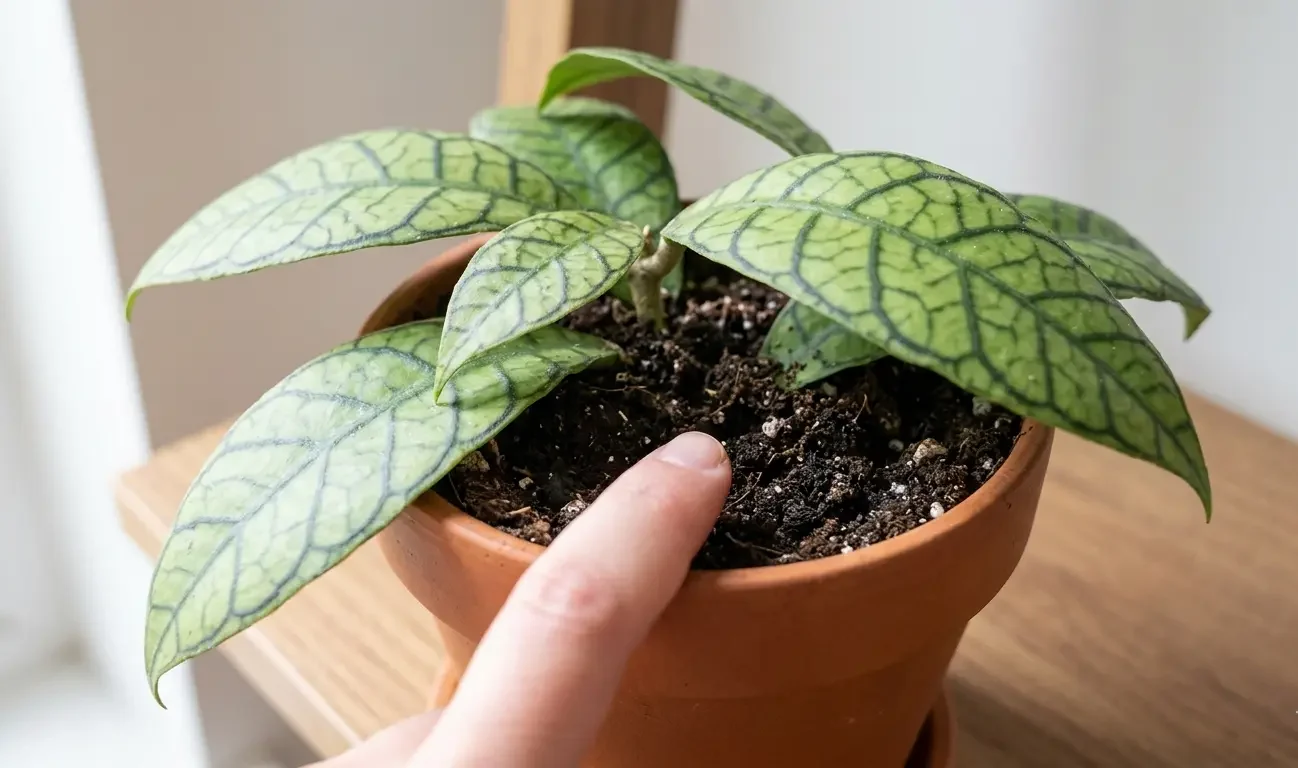
Water only when the top inch or two of soil has dried out, then water thoroughly until it drains and empty the saucer. In warm, bright months this might be weekly; in winter, much less. It is genuinely drought-tolerant, so when in doubt, wait.
Here is the quirk worth knowing: callistophylla’s leaves are so stiff and rigid that, unlike most Hoyas, they do not wrinkle or pucker noticeably when the plant is thirsty. With softer-leaved Hoyas you can read thirst from the leaves, but with this one you cannot, so you must go by the soil instead. Check the soil with a finger and water on that basis, not by waiting for a leaf signal that will not come.
The overwatering trap
Yellow, drooping, or mushy leaves with damp soil mean overwatering and possible root rot. Because the leaves will not warn you by wrinkling, it is especially easy to overwater this plant out of habit, so always confirm the soil is dry first.
The best soil and pot for a Hoya callistophylla
As a rainforest epiphyte, callistophylla wants a very loose, airy, fast-draining mix, much chunkier than ordinary potting soil.
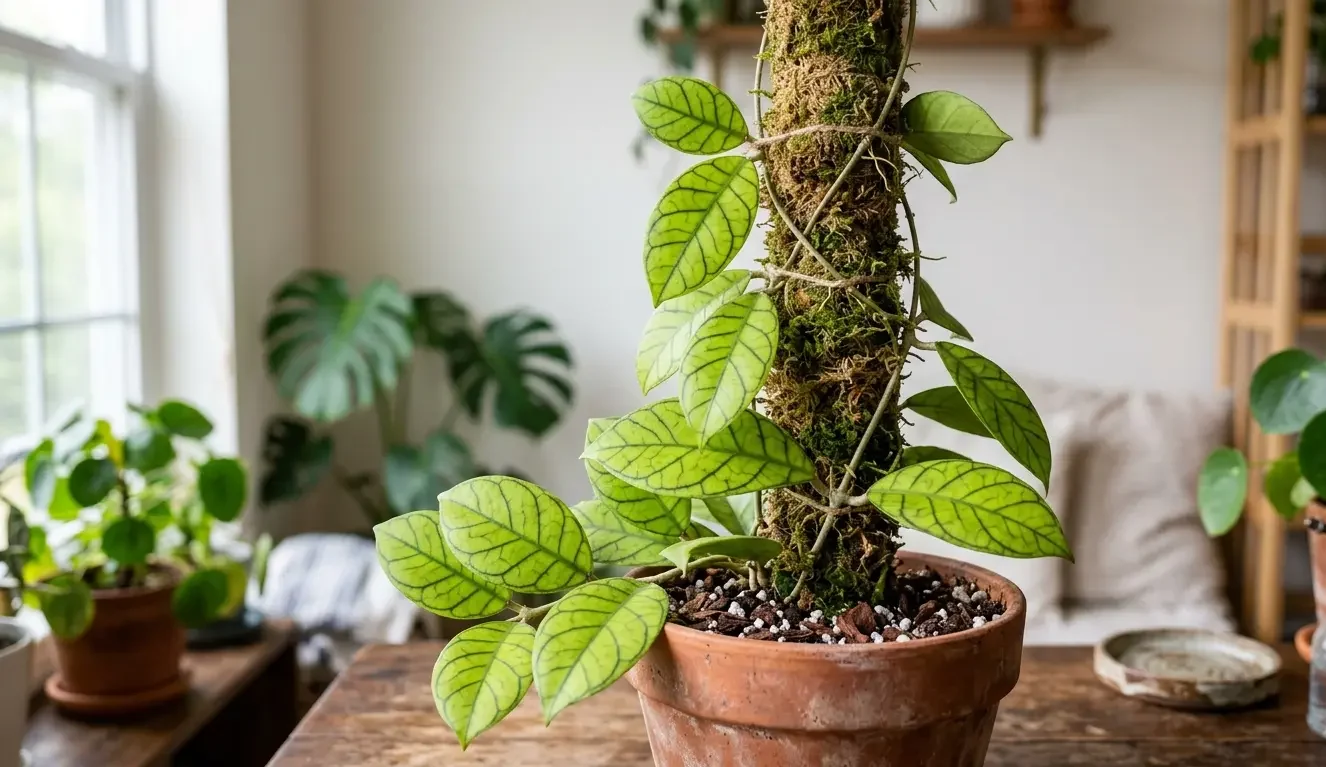
A good blend is about one part potting mix, one part orchid bark, and one part perlite, which drains fast and keeps air around the roots. Always use a pot with drainage holes. Like other Hoyas, it prefers to be a little root-bound, so do not over-pot it; a snug container only slightly larger than the roots keeps it healthiest and, once mature, more likely to bloom.
Humidity and temperature for a Hoya callistophylla
Coming from tropical rainforest, callistophylla appreciates warmth and humidity, though it adapts well to normal homes.
Keep it warm, roughly 18 to 27 degrees Celsius (65 to 80 Fahrenheit), and away from cold drafts. It does best with higher humidity but tolerates average household air thanks to its thick leaves. A pebble tray or small humidifier helps if your air is very dry, and a bit more humidity tends to bring out lusher, larger leaves.
Does a Hoya callistophylla need a moss pole?
Yes. Unlike the trailing Hoyas, callistophylla prefers to climb, and giving it support brings out its best.
In the wild it clambers up trees, and that vertical climb encourages larger, more dramatic leaves. Indoors, give it a moss pole or trellis, tying the stem loosely until it grabs on. Without support it will still grow, but it tends to sprawl, and the leaves stay smaller. A pole keeps it tidy and helps it produce the big, boldly veined foliage it is grown for.
How to fertilize and bloom a Hoya callistophylla
Feeding supports growth and the plant’s fragrant flowers.
Feed every four to six weeks through spring and summer with a balanced houseplant fertilizer diluted to half strength, and stop in winter. A higher-phosphorus bloom fertilizer can encourage flowering in a mature plant. When it blooms, callistophylla produces spherical clusters of small, star-shaped, creamy white to pale yellow flowers with a powerfully sweet fragrance. As with all Hoyas, never cut off the peduncle, the woody stalk the flowers grow from, because the plant reblooms from the same spot year after year. Strong bright light, a mature plant, and a snug pot are the keys to getting it to flower.
How to propagate a Hoya callistophylla
Callistophylla propagates from stem cuttings like other Hoyas.
Take a cutting with at least two nodes, the small bumps where leaves attach, and ideally a leaf or two. You can let the cut end callus for a day to reduce rot, then root the cutting in water or in your usual chunky mix, kept in bright indirect light and warmth. Roots appear over a few weeks, though this species can be a little slower than the fast carnosa types. Spring and summer are the best times to propagate.
Common Hoya callistophylla problems and how to fix them
Most callistophylla problems trace back to watering or light, and each has a clear fix.
Why are my callistophylla leaves yellow or mushy?
Yellow, soft, or mushy leaves usually mean overwatering and possibly root rot. Because the stiff leaves do not warn you by wrinkling, this is the easiest mistake to make. Let the soil dry out fully, check the roots, make sure the mix drains, and water less often.
Why are my callistophylla leaves losing their vein contrast?
Flat, uniformly dark leaves with little vein contrast usually mean not enough light. Move the plant to brighter indirect light, and new leaves should come in with the sharper, high-contrast veining the species is known for.
Why has my callistophylla stopped growing?
Stalled growth, with small or no new leaves, almost always means too little light, sometimes combined with cold. Move it somewhere brighter and warmer, give it a pole to climb, and growth should resume in the growing season.
Why won’t my Hoya callistophylla bloom?
Usually the plant is too young, not getting enough light, or in too large a pot. Give it strong bright indirect light, keep it slightly root-bound, be patient, and make sure you have not removed the peduncles.
A note on pet safety
Hoyas, including callistophylla, are generally considered non-toxic and pet-safe, which makes them a popular choice for homes with cats and dogs. As with any houseplant, it is still best not to let pets chew the leaves, since the Hoya genus contains a milky latex sap, but it is regarded as a pet-friendly plant rather than a poisonous one.
Is the Hoya callistophylla worth it?
Yes, and it punches above its reputation. It looks like a demanding collector plant, but it is really just a striking, easy Hoya that wants good light and a pole to climb. The dramatic veined leaves make it one of the most eye-catching plants you can own for the effort involved. My roundup of the best Hoya varieties for beginners shows where callistophylla sits among the other easy and collectible types.
Are you trying to sharpen the vein contrast, or troubleshooting yellow leaves? Leave a comment below and I will help you sort it out.
Frequently asked questions
Is Hoya callistophylla hard to care for?
Not really. It looks like a fussy collector plant but follows standard Hoya care, bright indirect light, an airy mix, and watering only when the soil dries. Its thick leathery leaves make it quite drought-tolerant and forgiving.
Why does my callistophylla have such dramatic dark veins?
That dark venation on lighter green leaves is simply the species’ natural feature, and the contrast is sharpest in bright indirect light. Older leaves tend to darken, and strong light lightens the green background, increasing the contrast.
How do I know when to water a Hoya callistophylla?
Water when the top inch or two of soil is dry. Unusually for a Hoya, its leaves are too stiff to wrinkle when thirsty, so you cannot rely on the leaf cue. Go by the soil, and err on the dry side since it is drought-tolerant.
Does Hoya callistophylla climb or trail?
It is a climber. It prefers to climb a moss pole or trellis rather than trail, and given support it grows larger, more dramatic leaves, with vines that can get very long over time.
Is Hoya callistophylla the same as Gunung Gading?
Yes. Gunung Gading is the same plant, named after the location in Malaysia where it was found. It is also often confused with the similar dark-veined Hoya finlaysonii, which has more splashed, erratic veining and wavier leaf edges.
How big does a Hoya callistophylla get?
Its stiff leaves commonly reach four to seven inches, and as an epiphytic climber its vines can grow very long over time, several feet or more, if given a pole or trellis to climb. It stays manageable in a pot indoors.
Is Hoya callistophylla toxic to pets?
Hoyas are generally considered non-toxic and pet-safe. As with all houseplants, it is still best not to let pets chew the leaves, since the genus has a milky latex sap, but it is regarded as a pet-friendly choice.
