


Hoyas, or wax plants, are among the most rewarding houseplants you can grow, easy to keep alive, hard to kill, and capable of producing clusters of star-shaped flowers so perfect they look carved from wax. Good Hoya care comes down to a few simple habits: bright indirect light, watering only when the soil has dried out, a very airy potting mix, and the patience to let the plant mature. Get those right and a Hoya will reward you for years, eventually with its famous fragrant blooms.
Short answer
Most Hoyas want bright indirect light, a very airy fast-draining mix, and watering only once the soil has dried out most of the way. They store water in their succulent leaves, so overwatering is the main danger. To get flowers, give strong light, keep the plant slightly root-bound, and never cut off the woody flower stalks. This guide covers each step.
This guide covers everything that applies across the genus, from light and water to soil, feeding, propagation, and the question every Hoya grower eventually asks: how to get it to bloom. If you are still choosing a plant, my roundup of the best Hoya varieties for beginners compares ten popular types by look and difficulty.
What is a Hoya?
A Hoya is a tropical vining plant, often called a wax plant or porcelain flower, grown both for its attractive thick leaves and for its clusters of fragrant, star-shaped, waxy flowers. There are hundreds of species, with leaves ranging from thick and round to long and needle-like, but they share a key trait: most are epiphytes, growing on trees rather than in the ground in the wild, with semi-succulent leaves that store water.
That epiphytic, water-storing nature is the single most useful thing to understand about Hoya care, because it explains almost everything else: why they want airy, fast-draining soil rather than dense potting mix, why they would rather dry out than stay wet, and why they like being a little root-bound. They are also non-toxic and pet-safe, which sets them apart from many popular houseplants.
Hoya care at a glance
Here is the whole routine in one table. Most Hoyas share these needs, with only small differences between species.
| Need | What Hoyas want |
|---|---|
| Light | Bright indirect light, a little gentle sun is fine |
| Water | When the soil has dried out most of the way |
| Soil | Very airy and fast draining, with bark and perlite |
| Humidity | Average is fine, a little more is appreciated |
| Temperature | 18 to 27 degrees Celsius, 65 to 80 Fahrenheit |
| Feeding | A balanced or high-phosphorus feed monthly in growth |
| Pot | Snug, only slightly larger than the roots |
| Toxicity | Non-toxic and pet-safe |
How much light does a Hoya need?
Light is the most important factor in Hoya care, and the single biggest reason a healthy-looking plant fails to flower.
Hoyas want bright indirect light. A spot right by an east or west window is ideal, where the plant gets a few hours of gentle morning or late-afternoon sun but is spared harsh midday rays that scorch the leaves. They will tolerate medium light, but in a dim spot they grow leggy, with long gaps between leaves, and rarely bloom. If you do not have a bright enough window, Hoyas respond very well to grow lights.
The link between light and flowers is direct: without enough bright light, most Hoyas simply will not bloom no matter how well you care for them otherwise. So if flowering is your goal, give the plant the brightest indirect spot you can.
Reading your plant’s light
Leggy growth with widely spaced leaves means more light is needed. Bleached or scorched patches mean too much direct sun. For flowers, err toward more bright indirect light rather than less.
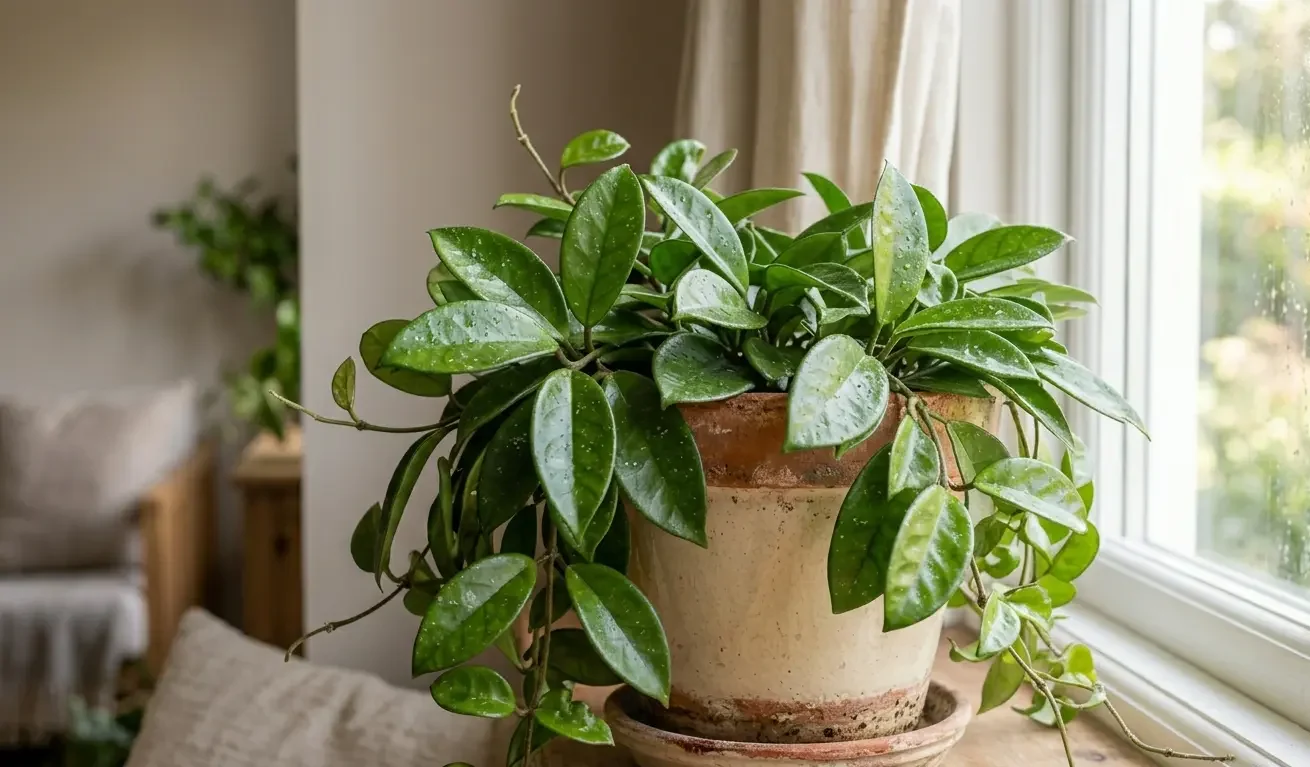
How often should you water a Hoya?
Watering is where most Hoyas are lost, and almost always from too much rather than too little. Because their leaves store water, Hoyas are built to handle drying out, and they hate sitting wet.
The simple rule is to let the soil dry out most of the way, then water thoroughly until it drains from the bottom, and empty the saucer so the pot never stands in water. In warm, bright months this might mean watering every week or two; in winter, when growth slows, much less often. Always go by the soil and the plant, not a fixed schedule.
Hoyas give you a helpful signal that other plants do not: their thick leaves. When a Hoya is getting genuinely thirsty, its leaves begin to pucker or wrinkle slightly. That is your cue to water. If the leaves are plump and firm, it does not need water yet. This makes Hoyas unusually easy to read once you learn the trick.
The overwatering trap
Soft, yellowing leaves with constantly damp soil mean overwatering and possible root rot, not thirst. Confusingly, an overwatered Hoya with rotting roots can also wrinkle, because the damaged roots cannot take up water. So always check the soil: wrinkling plus dry soil means water, wrinkling plus wet soil means check the roots.

The best soil for Hoyas
Because Hoyas are epiphytes that grow on tree bark rather than in soil in the wild, they want a very loose, airy, fast-draining mix, much chunkier than standard potting soil. Dense soil that holds water is the quickest way to cause root rot.
A good Hoya mix is something like one part standard potting mix, one part orchid bark, and one part perlite, which gives plenty of air pockets and drains freely. A cactus and succulent mix amended with extra bark and perlite also works well. The chunkier the mix, the more often you will need to water, but the plants grow stronger and healthier for it. Always use a pot with drainage holes.
Pot size: why Hoyas like to be snug
Pot choice matters more for Hoyas than for most houseplants, because it directly affects flowering.
Hoyas bloom best when they are slightly root-bound, so resist the urge to give them a big pot. Use a container only one or two inches wider than the root ball, and repot only every two to three years, or when the roots are genuinely bursting out. An oversized pot holds a large volume of wet soil that both raises the risk of rot and encourages the plant to put energy into roots and leaves rather than flowers. When you do repot, keep the root ball fairly intact and move up just one size.
Humidity and temperature for Hoyas
Hoyas come from tropical regions, so they like warmth and appreciate some humidity, though most adapt well to normal homes.
Keep them in normal room warmth, roughly 18 to 27 degrees Celsius (65 to 80 Fahrenheit), and away from cold drafts in winter. Most Hoyas are fine in average household humidity, though a little more brings out lusher growth, especially in thin-leaved types like Hoya linearis, which need higher humidity to keep their narrow leaves from drying out. A pebble tray or small humidifier helps if your air is very dry. Interestingly, a slightly cooler, drier rest in winter can actually help trigger spring blooms.
How to fertilize a Hoya
Feeding supports both healthy growth and, importantly, flowering, but the type of fertilizer matters.
Feed with a balanced houseplant fertilizer about once a month through spring and summer, diluted to half strength, and stop in autumn and winter. If your goal is flowers, a fertilizer higher in phosphorus (the middle number) encourages blooming, while too much nitrogen pushes leafy growth at the expense of flowers. Some growers use an orchid bloom fertilizer for this reason. As always, do not overfeed, since salt buildup damages the roots.
How to get a Hoya to bloom
This is the question every Hoya grower eventually asks, because the flowers are the whole reward, and a healthy Hoya can still stubbornly refuse to bloom. Here is what actually matters.
First, give it plenty of bright indirect light. This is the number one factor; a Hoya in low light will almost never flower. Second, keep it slightly root-bound in a snug pot, since a cramped root system encourages the plant to flower rather than just grow. Third, do not overwater, and consider a phosphorus-leaning fertilizer in the growing season. Fourth, be patient: many Hoyas, especially those grown from cuttings, take a few years to mature before they bloom at all.
And the single most important rule, the one beginners get wrong: never cut off the peduncle. The peduncle is the short, woody flower stalk that the blooms grow from. Hoyas rebloom from the same peduncle year after year, so if you trim it off after the flowers fade, thinking it is dead, you remove next season’s flowers. Leave it in place, even when it looks bare. Likewise, try not to move the plant while it is budding or blooming, as Hoyas dislike being disturbed mid-cycle and may drop their buds.

How to propagate a Hoya
Hoyas are easy to propagate from stem cuttings, which is a lovely way to expand your collection or share plants.
Take a cutting with at least two nodes, the small bumps where leaves attach, and ideally a couple of leaves. Some growers let the cut end sit out for a day to callus over, which lowers the risk of rot. Then root the cutting in water or straight into your usual chunky mix, kept in bright indirect light. Roots appear over a few weeks, and once they are established you can grow the cutting on as a new plant. Occasionally a cutting even comes with a peduncle and may bloom while young, but in general expect a propagated Hoya to take a while to mature.

Common Hoya problems and how to fix them
Most Hoya troubles trace back to watering or light. Here is how to read the signs.
Why are my Hoya leaves wrinkling?
Wrinkled, puckered leaves mean dehydration. Usually that is simple thirst, so check the soil and water if it is dry. But an overwatered Hoya with rotting roots also wrinkles, because the damaged roots cannot absorb water, so if the soil is wet and the leaves are wrinkling, inspect the roots for rot.
Why are my Hoya leaves turning yellow?
Yellow, soft leaves usually mean overwatering. Let the soil dry out properly, make sure the mix is airy and the pot drains, and ease off the watering.
Why won’t my Hoya bloom?
The usual reasons are not enough light, a plant that is still too young, a pot that is too large, or overwatering. Give it more bright light, keep it slightly root-bound, be patient, and make sure you have not cut off the peduncle.
Why is my Hoya leggy with few leaves?
Long, bare stretches of vine mean not enough light. Move the plant somewhere brighter, and the new growth will come in fuller and closer together.
Why is my Hoya dropping leaves or blackening?
Leaf drop and blackening stems usually point to overwatering, soggy soil, or cold conditions, especially in winter. Let it dry out, keep it warm, and check the roots for rot if it continues.
A note on pet safety
One of the nicest things about Hoyas is that they are considered non-toxic and pet-safe. Unlike philodendrons, pothos, and many other popular houseplants that contain calcium oxalate crystals, Hoyas are a worry-free choice for homes with cats and dogs that like to nibble. As always, it is still best not to encourage any pet to eat houseplants, but a Hoya will not poison them.
Choosing your Hoya
Once the care basics make sense, the fun part is choosing which types to grow. The tough, forgiving species like Hoya carnosa, pubicalyx, and australis are the best place to start, while novelties like the heart-leaved Kerrii and the twisted Hindu Rope add character, and trailing types like Linearis and Curtisii look wonderful cascading from a shelf.
For a full comparison of popular types by look and difficulty, see my guide to the best Hoya varieties for beginners. It walks through ten of them and points you to the right one for your space and experience level.
Which Hoya are you growing, and are you trying to get it to bloom for the first time? Leave a comment below with what is happening and I will help you work out what it needs.
Frequently asked questions
How often should I water a Hoya?
Let the soil dry out most of the way, then water thoroughly. Hoyas store water in their succulent leaves, so they prefer to dry between waterings and are far more often killed by overwatering than by neglect. In winter, water even less.
How do I get my Hoya to bloom?
Give it plenty of bright indirect light, keep it slightly root-bound in a snug pot, do not overwater, and never cut off the woody flower stalks. Many Hoyas also need a few years to mature before they flower, so patience matters.
Why should I never cut a Hoya’s flower stalk?
That stalk is the peduncle, and Hoyas rebloom from the same peduncle year after year. Cutting it off removes next season’s flowers, so always leave it even after the blooms have faded.
What kind of soil do Hoyas need?
A very airy, fast-draining mix. A blend of regular potting mix with plenty of orchid bark and perlite, or a cactus and succulent mix amended with bark, works well. Dense, water-retaining soil causes root rot.
How long do Hoya flowers last and do they come back?
Individual flower clusters usually last one to two weeks, sometimes up to three. They come back because Hoyas rebloom from the same peduncle, so leave that woody flower stalk in place and the plant will flower from it again.
Do Hoyas need a lot of light?
Yes. Bright indirect light is essential, especially for flowering. In low light a Hoya survives but grows leggy and rarely blooms. A few hours of gentle morning or late-afternoon sun is fine; harsh midday sun scorches the leaves.
Are Hoyas toxic to pets?
No. Hoyas are considered non-toxic and pet-safe, which makes them a good choice for homes with cats and dogs, unlike many popular foliage plants.
How fast do Hoyas grow?
Most are slow to moderate growers, with a faster flush in warm, bright months and little growth in winter. Fast types like Pubicalyx and Australis are the exception. Bright light and warmth speed things up.
