

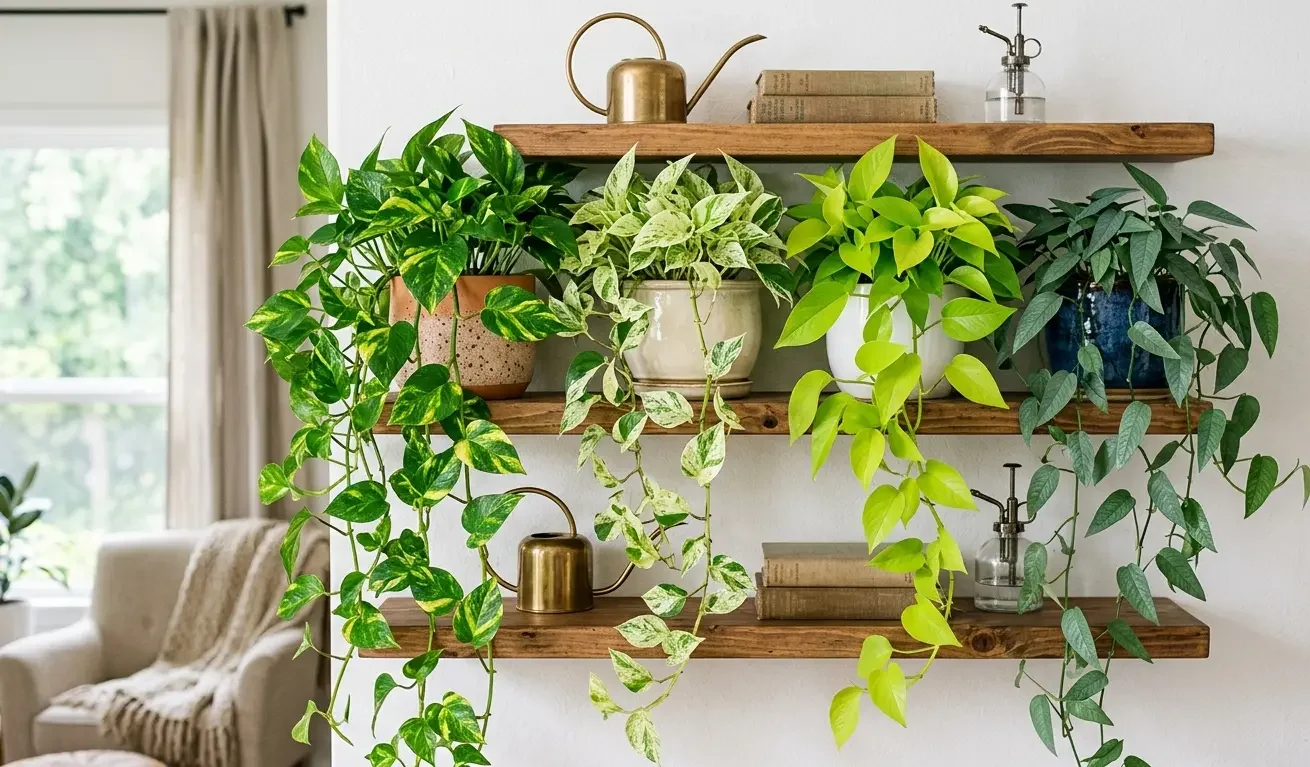
Pothos is the workhorse of the houseplant world. It tolerates low light, forgives erratic watering, and grows fast enough to trail down a bookshelf within a season. Most people know it as the green-and-yellow office vine. But there are at least a dozen cultivars in circulation, with real differences in pattern and growth.
This roundup ranks the 10 best pothos varieties for indoor growers, from the easiest entry points to the rarest collector picks. I have also flagged the species-level distinctions where they matter, because not every plant sold as a “pothos” is technically Epipremnum aureum.
Quick answer
For beginners, Golden, Jade, and Neon are the easiest pothos varieties to start with. Marble Queen and N’Joy are the next step up. Manjula, Pearls and Jade, Cebu Blue, and Snow Queen are collector picks that need slightly more light and patience. Harlequin and Global Green are the rarest. All true pothos are toxic to pets.
A quick note on what counts as a pothos
True pothos in the houseplant trade refers to cultivars of Epipremnum aureum. A few popular plants sold as pothos are actually different species or genera:
Cebu Blue is Epipremnum pinnatum, a related but distinct species. It is universally sold as pothos and cared for the same way, so I have included it here.
Satin pothos and silver pothos are usually Scindapsus pictus, a completely different genus. They are excellent plants but technically not pothos, so they are not in this ranking.
Manjula was originally classified as Epipremnum pinnatum ‘HANSOTI14’ in its patent, but is sold as an aureum cultivar. I include it because the trade and care treat it as a pothos.
This distinction matters for accuracy but not for daily care. All of the plants below are grown similarly and benefit from the same general approach.
1. Golden Pothos
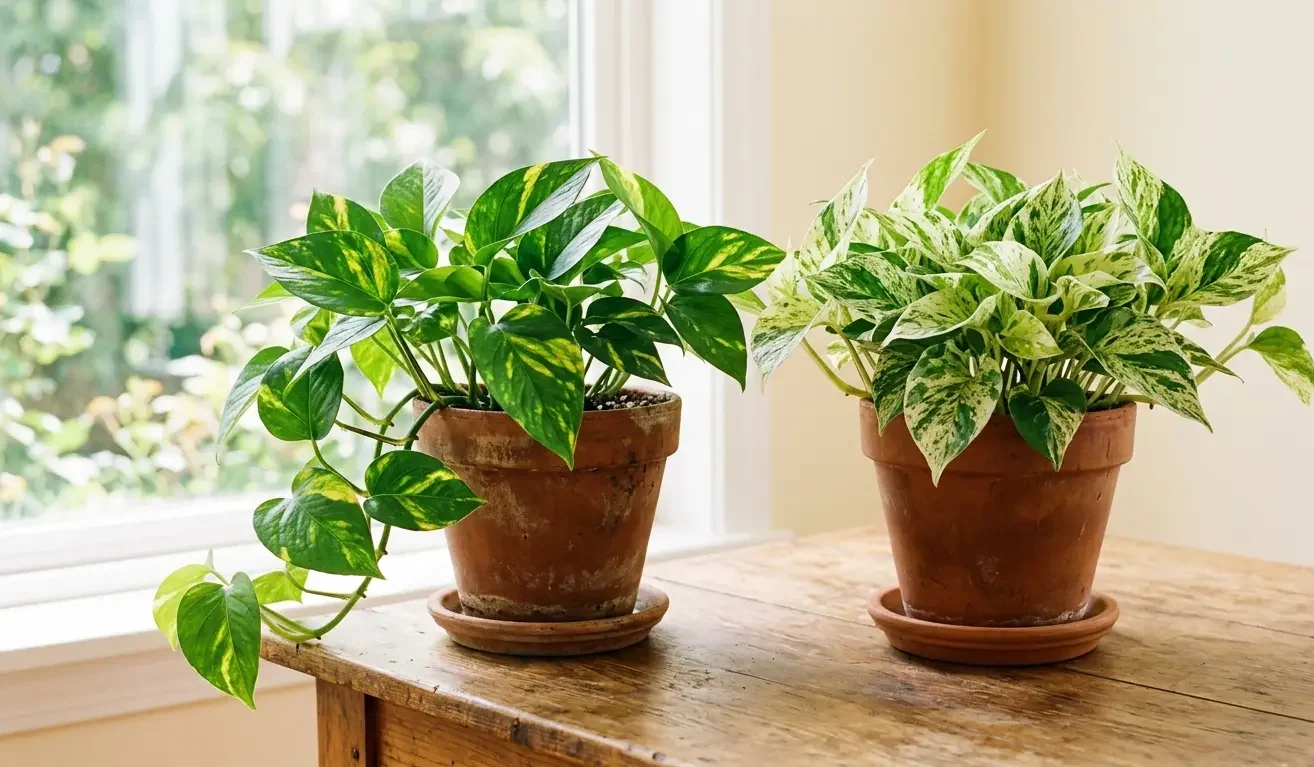
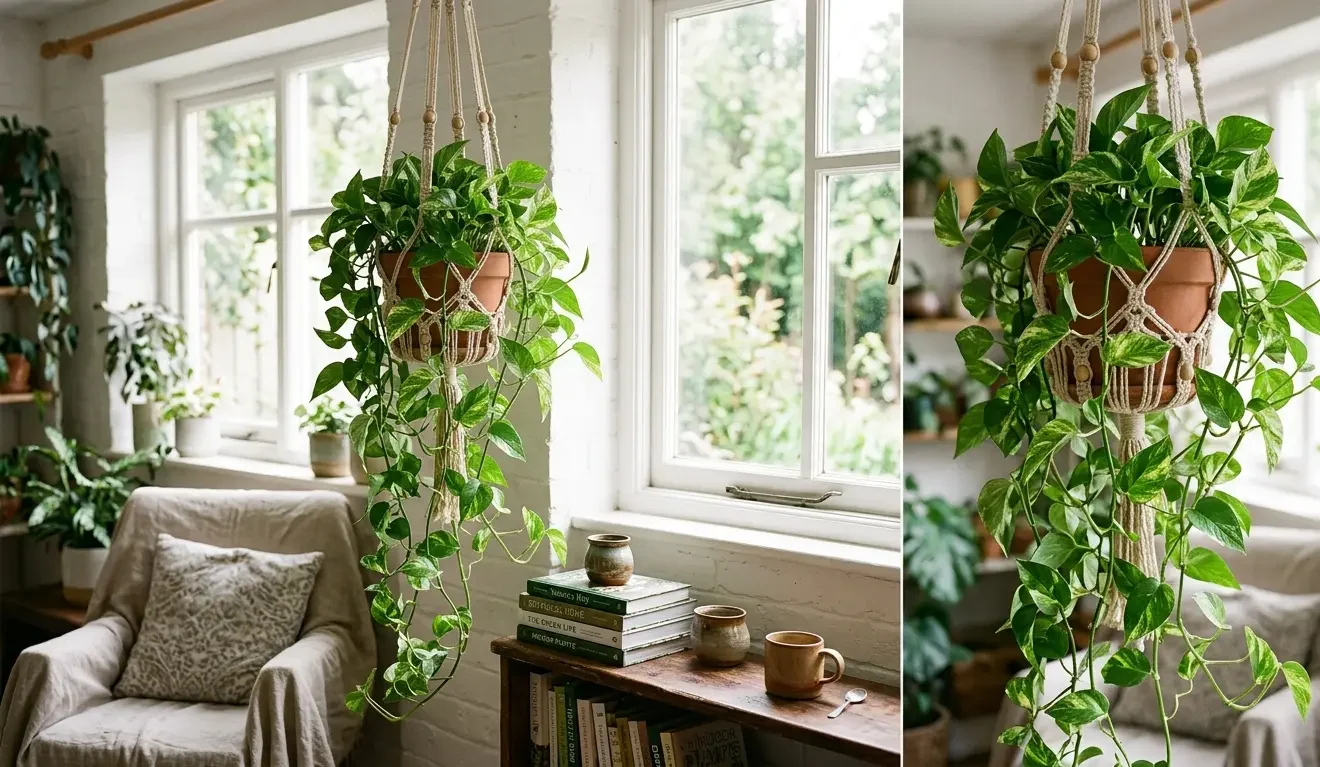
Golden pothos is the original and still the gold standard. Glossy green heart-shaped leaves with irregular yellow variegation, fast growth, and a tolerance for almost any indoor condition. It is the easiest pothos and the easiest plant to recommend to anyone starting out.
It thrives in bright indirect light but will keep going in medium and even low light, just with less variegation and slower growth. Water when the top inch of soil dries. Propagation is genuinely effortless: snip below a node, root in water, plant in soil.
- Light: Low to bright indirect
- Growth rate: Fast
- Availability: Everywhere
- Best for: Beginners, low-light spots, fast filling of empty shelves
2. Marble Queen Pothos
Marble Queen has heavy creamy-white and green marbled variegation across each leaf, sometimes reaching 50 percent white. It is slower than golden pothos because the white parts contain less chlorophyll, but in good light it produces stunning, almost painterly foliage.
It needs brighter indirect light than golden pothos to hold its variegation; in low light, new growth tends to revert greener. Treat it like a slightly more demanding golden pothos.
- Light: Bright indirect
- Growth rate: Moderate
- Availability: Very common
- Best for: Bright spots where you want lots of variegation
3. Neon Pothos
Neon pothos has chartreuse to lime-green leaves with no variegation. It looks almost artificial in person, in a good way, and it brightens dark corners without needing variegation to do it. The color is most vivid on new growth.
It grows slightly slower than golden pothos but is otherwise just as forgiving. The neon color tends to fade toward standard green in low light, so a medium to bright spot keeps it at its best.
- Light: Medium to bright indirect
- Growth rate: Fast
- Availability: Common
- Best for: Adding a bright pop of color without variegation
4. Jade Pothos
Jade pothos is the solid-green version. No variegation, no markings, just glossy heart-shaped leaves on fast-growing vines. It is sometimes treated as the “boring” pothos, but it is also one of the most reliable, the most tolerant of low light, and the fastest growing of all the varieties.
If you want a pothos that does not require careful light placement to look its best, this is it. It is also the cheapest and most widely available, often sold simply as “pothos” without a cultivar name.
- Light: Low to bright indirect
- Growth rate: Very fast
- Availability: Everywhere
- Best for: Low-light spots, true beginners, fast green coverage
5. N’Joy Pothos
N’Joy has small to medium leaves with sharply defined patches of bright white and green, more crisply sectored than Marble Queen’s marbled look. The variegation pattern is consistent and reliable, with clear boundaries between colors rather than blended mottling.
It grows slower than the green or yellow-variegated types because of the white sections, and it needs decent indirect light to hold the contrast. New leaves tend to come out heavily white, then green up slightly as they mature. The compact growth makes it well suited to small pots and short shelves.
- Light: Bright indirect
- Growth rate: Moderate
- Availability: Common
- Best for: Crisp variegation, smaller spaces, contrast against dark backgrounds
6. Pearls and Jade Pothos
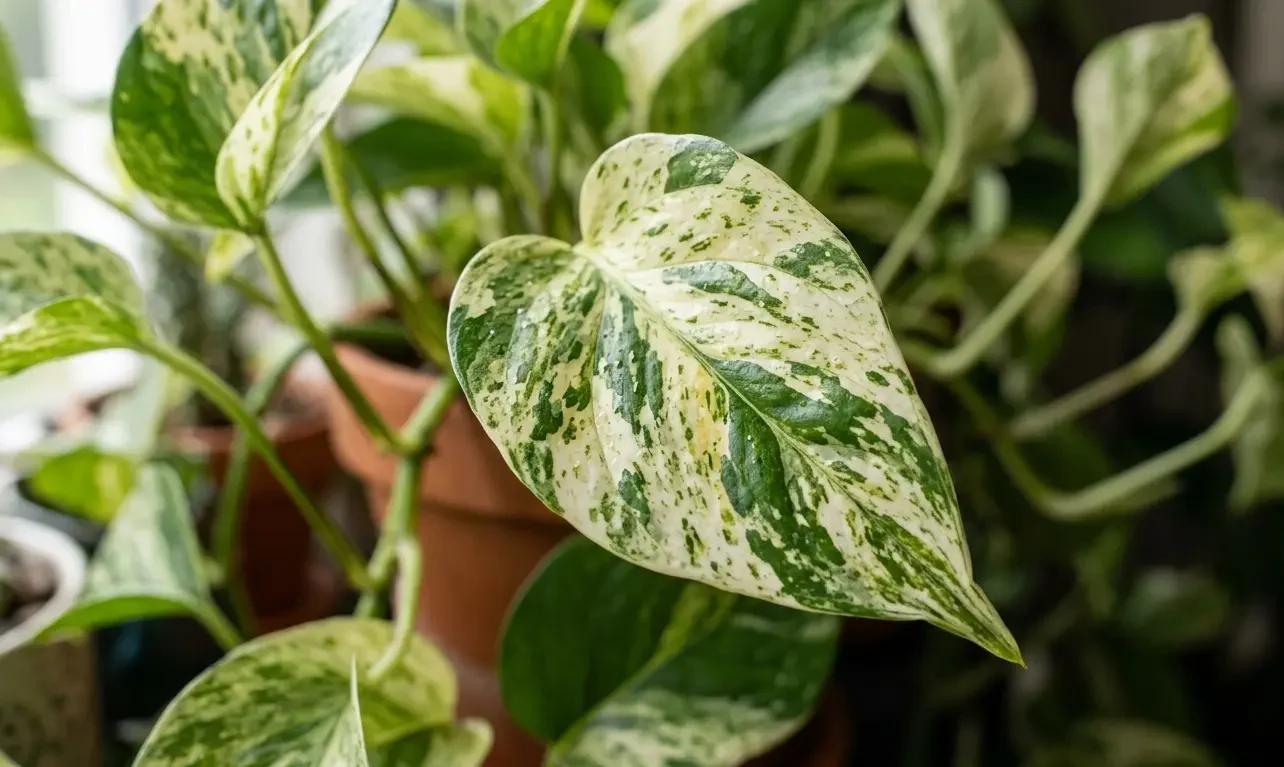
Pearls and Jade was developed at the University of Florida and is a sport of the Marble Queen. The leaves are smaller, often more pointed, with cream-white and green sections plus distinctive silvery-grey patches that give it real depth.
It is slower-growing than most pothos and needs brighter indirect light to maintain its variegation. The leaf size and shape make it more delicate-looking than the chunky Marble Queen, but the care is similar. A nice mid-tier collector variety that is still relatively easy to find.
- Light: Bright indirect
- Growth rate: Slow to moderate
- Availability: Specialty shops, sometimes big box
- Best for: Variegation collectors who want something a step up from Marble Queen
7. Manjula Pothos
Manjula pothos (patented as Epipremnum ‘HANSOTI14’) is one of the most striking variegated cultivars in cultivation. The broad, wavy-edged leaves have a swirling mix of cream, white, light green, and dark green, with no two leaves looking alike. It was developed in India and patented through the University of Florida.
The growth is denser and more mounding than typical pothos, with shorter internodes, so the plant looks fuller and less leggy. It is slower than standard pothos, needs brighter indirect light to keep its variegation, and is more sensitive to overwatering because the heavily variegated tissue is more delicate.
- Light: Bright indirect
- Growth rate: Slow
- Availability: Specialty shops and online
- Best for: Collectors who want a showpiece pothos
8. Cebu Blue Pothos
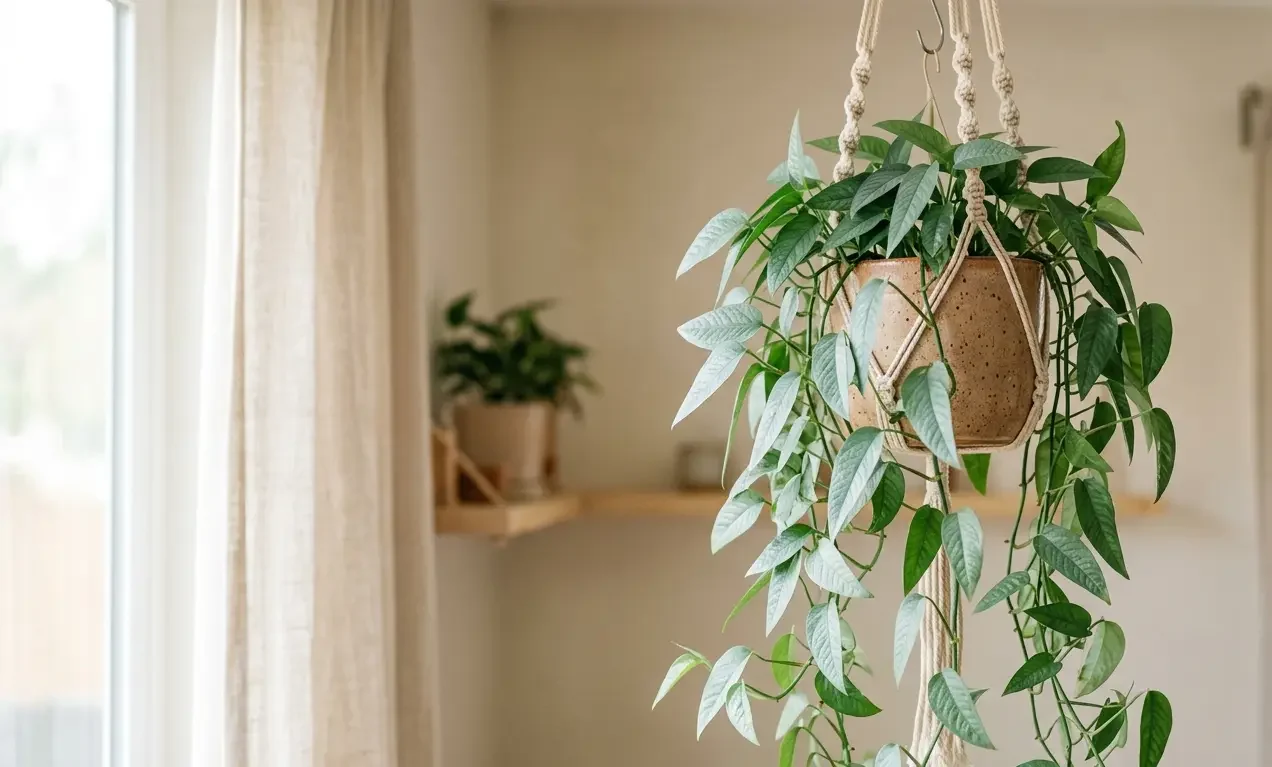
Cebu Blue is technically Epipremnum pinnatum, not aureum, so it is a different species treated as a pothos in the trade. The juvenile foliage you almost always see for sale has narrow, lanceolate leaves with a silvery blue-green metallic sheen, completely different in shape from typical pothos.
Mature plants in their native range or with strong support and bright light can develop large, fenestrated leaves similar to Monstera. Indoors it usually stays in juvenile form unless given a moss pole and excellent conditions. Care is similar to other pothos with a preference for bright indirect light.
- Light: Bright indirect
- Growth rate: Moderate
- Availability: Specialty shops, increasingly common online
- Best for: Anyone wanting a non-standard pothos shape and color
9. Snow Queen Pothos
Snow Queen has the most extreme variegation of the common pothos varieties, often 70 to 80 percent bright white per leaf, with thin green streaks rather than blocks. It is genuinely stunning when healthy, but the high white content makes it slow, fussy, and prone to reverting in low light.
It needs bright indirect light to maintain its variegation and benefits from slightly drier conditions and warmer temperatures than greener varieties. Beginners often confuse it with Marble Queen at the store; Snow Queen is whiter, cooler in tone, and less hardy. For full detail, see our Snow Queen vs Marble Queen comparison.
- Light: Bright indirect (mandatory)
- Growth rate: Slow
- Availability: Specialty and online
- Best for: Experienced growers in bright homes who want maximum white
10. Global Green Pothos
Global Green is a newer cultivar with a striking dark-green and light-green marbled pattern, no white or yellow. Each leaf looks like a pothos that decided to do its variegation in two shades of green instead of swapping in pale tissue.
Because there is no chlorophyll-poor tissue, it grows nearly as fast as solid-green pothos and tolerates lower light than the heavily variegated cultivars. It is one of the more interesting recent introductions to the market and is becoming easier to find. A good choice for collectors who do not love cream or yellow variegation.
- Light: Medium to bright indirect
- Growth rate: Moderate to fast
- Availability: Specialty shops, increasingly common
- Best for: Anyone wanting unusual variegation without sacrificing vigor
Honourable mentions
A few varieties did not make the top 10 but are worth knowing about:
Harlequin pothos is the rarest cultivar in serious circulation. It looks like a more extreme Manjula, with leaves that can be nearly pure white. The variegation is genetically unstable, so plants frequently revert, and prices are high. It is a collector trophy, not a daily houseplant.
Hawaiian pothos is a cultivar with larger, more elongated leaves than golden pothos and slightly bolder yellow variegation. It grows large quickly and is great for mature climbing displays on moss poles.
Lemon Meringue pothos is a newer variegated cultivar with lemon-yellow markings and a wavy leaf edge similar to Manjula but with yellow rather than white tones. Still uncommon.
How to choose the right pothos for your space
The right variety depends on your light and your patience.
For low light, stick with Jade or Golden. They keep growing and looking healthy when other varieties stall or revert.
For medium to bright indirect light, almost anything works: Marble Queen, Neon, N’Joy, Pearls and Jade, Global Green.
For truly bright spots near a window, the heavily white-variegated cultivars (Snow Queen, Manjula, Harlequin) finally get the light they need to keep their variegation stable.
For fast results, Jade and Golden grow most quickly. For a showpiece, Manjula, Pearls and Jade, or Cebu Blue have the most distinctive look.
Quick variety identification
If a pothos has yellow streaks, it is Golden or Hawaiian. If it has white and green marbling, it is Marble Queen (older leaves), Snow Queen (more white), or N’Joy (sharper sections). If the white runs through wavy or large leaves, it is Manjula. If the leaves are narrow and silvery, it is Cebu Blue. If everything is one color, it is Jade (deep green), Neon (lime), or Global Green (two greens).
A note on toxicity and pet safety
All true pothos varieties contain calcium oxalate crystals and are toxic to cats and dogs if chewed. Symptoms include oral irritation, drooling, vomiting, and difficulty swallowing. This applies to every cultivar above, no pothos is pet-safe.
If you have curious pets, consider keeping pothos out of reach, training pets to avoid plants, or choosing a pet-safe alternative. Our pet-safe houseplant roundup covers safer options including hoyas, peperomias, and Calatheas. For a focused trailing option, string of hearts is pet-safe and grows similarly.
Final thoughts
If you are buying your first pothos, start with Golden or Jade. They are forgiving, fast, and look great. From there, work up through Marble Queen and Neon, then into the patterned cultivars like N’Joy, Pearls and Jade, and Manjula as your light situation and confidence allow.
The taxonomy quirks are worth knowing about but should not stop you from buying anything. Cebu Blue is universally sold as a pothos, Manjula is treated as one, and daily care is the same across the genus. Just know what you are buying when something is labeled “satin pothos” (Scindapsus) at the store.
Frequently Asked Questions
What is the rarest pothos variety?
Harlequin pothos and Pothos Manjula (HANSOTI14) are among the rarest and most expensive cultivars, with Harlequin showing extreme white variegation that is genetically unstable. Snow Queen, Pearls and Jade, and Cebu Blue are easier to find but still considered uncommon at typical big box stores.
Which pothos variety is the easiest to care for?
Golden pothos and Jade pothos are the easiest. Both tolerate low light, irregular watering, and average humidity, and they grow quickly. Marble Queen is slightly fussier because its variegation needs brighter light to hold.
Is satin pothos a true pothos?
No. Satin pothos is Scindapsus pictus, a different genus from true pothos (Epipremnum aureum). It looks similar, with silver-marked dark green leaves, but its care needs and growth habit are slightly different. It is fine to grow either way, just know what you are buying.
Is Cebu Blue a real pothos?
It is sold as one and shares similar care needs, but it is actually Epipremnum pinnatum, a related species rather than a cultivar of Epipremnum aureum. The juvenile leaves are narrow and silvery blue; mature plants can develop fenestrations like a Monstera.
Are all pothos varieties toxic to pets?
Yes. All true pothos (Epipremnum aureum) and the closely related Epipremnum pinnatum varieties like Cebu Blue contain calcium oxalate crystals and are toxic to cats and dogs. If you need a pet-safe trailing plant, look at hoyas, peperomias, or string of hearts instead.
