


Anthuriums are two hobbies in one plant. To most people, an Anthurium is the cheerful flamingo flower with glossy red, heart-shaped blooms in every grocery store. But there is a whole other world of collector Anthuriums grown not for flowers at all, but for massive, deeply veined leaves that look carved from dark velvet. Knowing which camp you are shopping in is the single most useful thing when choosing an Anthurium, so this guide is organized around exactly that split.
Short answer
If you want an easy, colorful, blooming houseplant, start with a flowering Anthurium like the classic andraeanum. If you are after dramatic foliage and do not mind fussing over humidity, the velvet-leaf types like clarinervium, crystallinum, and the prized Queen are the collector plants worth chasing. The list below covers both, sorted from easiest to most demanding.
I have grouped these ten into the two real-world categories, the easy flowering types first, then the velvet-leaf foliage types, and noted the care level for each. If you want the full care routine that applies across the genus, my Anthurium care guide covers light, watering, humidity, and the differences between the two groups in depth.
The two kinds of Anthurium
Before the list, it helps to understand the split, because the two groups want noticeably different things.
Flowering Anthuriums, led by Anthurium andraeanum, are grown for their colorful waxy spathes, the glossy “flower” that is actually a modified leaf, with a tail-like spadix in the center. These are the easy, widely sold houseplants that bloom for months and tolerate normal homes. Foliage Anthuriums are grown for their leaves: thick, velvety, dramatically veined foliage in deep green, often with pale silver or white veins. Their flowers are unremarkable and many growers remove them so the plant puts energy into leaves. These are the collector plants, more demanding, especially about humidity, but spectacular.
| Group | Grown for | Difficulty |
|---|---|---|
| Flowering (andraeanum and hybrids) | Colorful waxy spathes | Easy |
| Foliage (clarinervium, Queen, etc.) | Velvety veined leaves | Moderate to demanding |
The best flowering Anthuriums
These are the easy, blooming types, the best place to start.
1. Anthurium andraeanum (Flamingo Flower)
Quick take: The classic, easiest Anthurium, grown everywhere for its long-lasting glossy spathes.
This is the Anthurium most people picture: heart-shaped, waxy, glossy spathes in red, pink, white, or coral, with a straight spadix in the center, held above deep green leaves. It blooms for months at a time and rebloom readily in good light, and it is forgiving of normal household conditions. If you want a colorful, rewarding flowering houseplant and an easy introduction to the genus, start here.

2. Anthurium ‘Red Princess’ and colorful hybrids
Quick take: Vibrant andraeanum-type hybrids in scarlet and other bold colors, just as easy as the classic.
Breeders have produced countless flowering hybrids from andraeanum, sold under names like Red Princess and a rainbow of color selections. They share the same easy care, large waxy spathes in intense colors, thick heart-shaped leaves, and months of bloom with bright indirect light and warmth. If you love the flamingo flower look but want a particular color, these hybrids are the way to get it.
3. Anthurium ‘Black’ types (e.g. watermaliense)
Quick take: A dramatic flowering type with deep purple, almost black spathes for something different.
For a moodier take on the flowering Anthurium, the so-called black Anthuriums, such as Anthurium watermaliense, produce spathes in such deep purple they look nearly black. The care is the same as other flowering types, but the dark, glossy blooms make a striking, unusual display. A fun pick once you have grown a standard flamingo flower and want something more dramatic.
The best foliage (velvet-leaf) Anthuriums
Now the collector plants, grown for spectacular leaves rather than flowers. These reward you with foliage, but they ask for higher humidity and more attention.
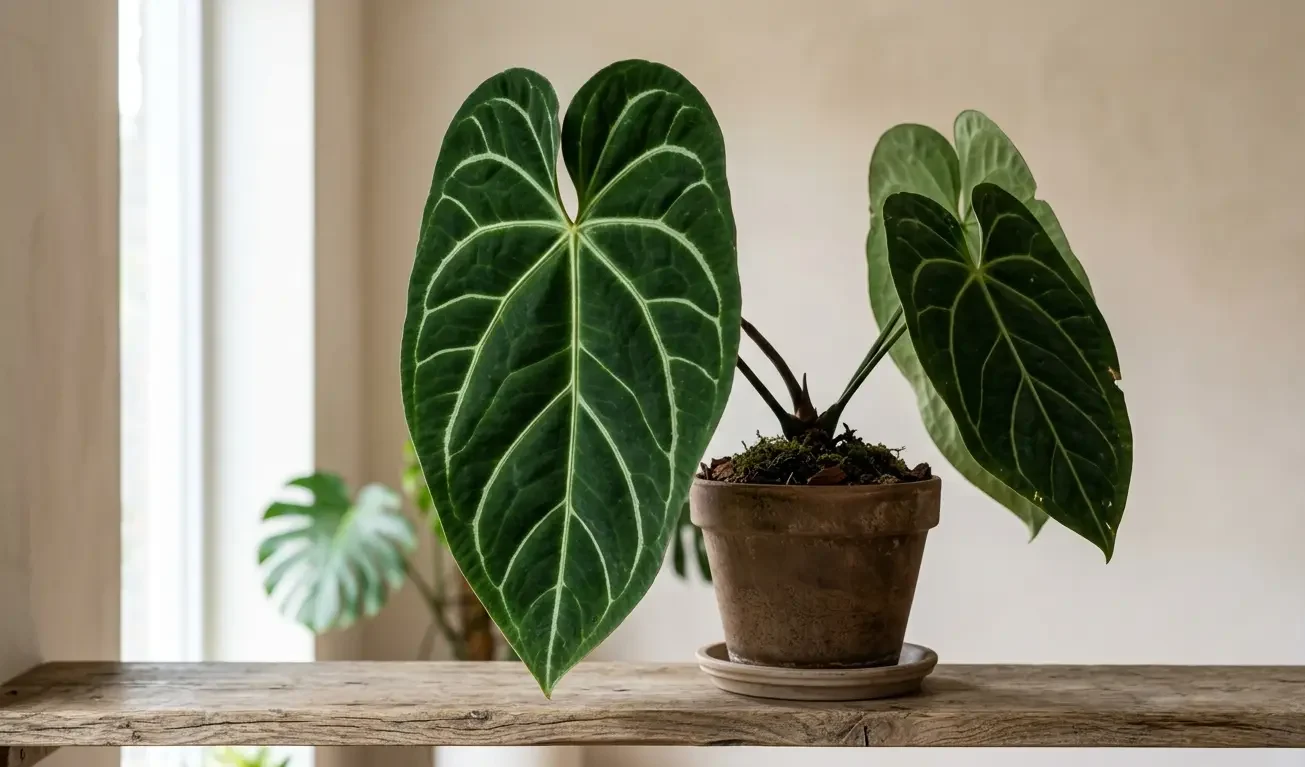
4. Anthurium clarinervium
Quick take: The most popular velvet-leaf Anthurium and the best entry point into the foliage types.
Clarinervium is the one that hooks most people on foliage Anthuriums. It has thick, stiff, heart-shaped leaves in deep velvety green, dramatically marked with bold ivory-white veins, sometimes called the velvet cardboard anthurium for its sturdy texture. It stays more compact than the giant velvet types and is a little more tolerant, which makes it the recommended first foliage Anthurium. It still wants high humidity and an airy mix, but it is the most achievable of the velvet-leaf group.

5. Anthurium crystallinum
Quick take: A close cousin of clarinervium with longer, more oval leaves and a shimmering, crystalline vein pattern.
Crystallinum is right beside clarinervium in popularity, offering a slightly different velvet look: its leaves are longer, more oval, and can grow larger, with thinner veins that have a crystalline, almost sparkling shimmer when light hits them. It is grown the same way as clarinervium and is similarly achievable for a careful grower ready to provide good humidity. The two are often confused, and both are excellent first velvet Anthuriums.

6. Anthurium magnificum
Quick take: A larger velvet Anthurium with big, rounded leaves and bold pale veins, for when you want size.
Magnificum lives up to its name with large, broad, velvety leaves marked by pronounced pale veins, and distinctive winged leaf stems. It grows bigger than clarinervium and crystallinum and makes a real statement once established. It is a step up in size and presence, wanting the same high humidity and airy care, and is a favorite among foliage collectors building toward the giant velvet types.
7. Anthurium warocqueanum (Queen Anthurium)
Quick take: The Queen, a prized large velvet Anthurium with long, pendulous, silver-veined leaves.
The Queen Anthurium is one of the most coveted plants in the genus, with long, elongated, lance-shaped velvety dark-green leaves laced with striking silver-white veins. In ideal conditions those leaves can grow several feet long, which is why it is often grown in a hanging basket or on a high shelf to let the foliage drape. It is demanding, needing consistently high humidity and warmth, and is a plant to graduate to once you have the velvet-leaf basics down, but few plants are as spectacular.

8. Anthurium veitchii (King Anthurium)
Quick take: The King, famous for enormous, rippled, pendulous leaves with a corrugated texture.
If the Queen has the long silver-veined leaves, the King has size and texture: Anthurium veitchii produces large, pendulous leaves with a deeply rippled, corrugated surface that can grow enormous in maturity. It is a dramatic, architectural plant and another demanding collector species, wanting high humidity and careful watering. The King and Queen together are the trophy plants of the foliage Anthurium world.

9. Anthurium ‘Ace of Spades’ / forgetii
Quick take: Dark, dramatic velvet leaves, with forgetii notable for having no sinus (no notch at the top).
For the darkest velvet look, types like the Ace of Spades offer broad, deep, almost black-green velvet leaves. A related collector favorite, Anthurium forgetii, breaks the usual heart shape by lacking a sinus, the notch where the two top lobes normally meet, so its leaves are fully rounded ovals, often with silver flecking along the veins. It is praised for holding many leaves at once, making a fuller plant. A distinctive pick for collectors who want something a little different.
10. Anthurium vittarifolium (Strap-leaf Anthurium)
Quick take: A pendulous oddity with extremely long, thin, ribbon-like leaves.
For something completely different, the strap-leaf Anthurium trades broad velvet leaves for very long, narrow, ribbon-like pendulous foliage that can hang several feet down, marked with fine veining. It is a striking, sculptural plant for a hanging spot, and shows just how much variety this single genus contains. A fun, unusual choice that looks nothing like the flamingo flower most people start with.
How to choose the right Anthurium for you
The first question is which camp you are in. If you want an easy, colorful, blooming houseplant, choose a flowering type, the classic andraeanum flamingo flower or one of its bright hybrids, and you will get months of color with simple care.
If it is the dramatic foliage that has caught your eye, start with clarinervium or crystallinum, the most achievable velvet-leaf types, before working up to the larger magnificum and the trophy King and Queen, which demand consistently high humidity. Be honest with yourself about whether you can provide 60 percent or more humidity reliably, since that is the make-or-break factor for the velvet types.
Whichever you choose, the core needs rhyme: bright indirect light, a chunky airy mix, careful watering that never leaves the roots soggy, and warmth. One important note for pet owners: unlike the pet-safe Hoyas, Anthuriums are toxic to cats and dogs if chewed, so place them out of reach.
New to the genus? My Anthurium care guide walks through light, watering, humidity, feeding, and how the flowering and foliage types differ in care, and it is the best next read before you bring one home.
Are you drawn to the flowering flamingo flowers or the velvet-leaf collector types? Tell me in the comments which way you are leaning and I will help you choose.
Frequently asked questions
What is the easiest Anthurium for beginners?
The flowering Anthurium andraeanum, the classic flamingo flower, is the easiest and most widely available. It is forgiving, blooms for months, and adapts to normal homes. The velvet-leaf foliage types are more demanding and better as a second step.
What is the difference between flowering and foliage Anthuriums?
Flowering types like andraeanum are grown for their colorful waxy spathes (the “flower”) and are easy houseplants. Foliage types like clarinervium and the Queen are grown for dramatic velvety, veined leaves, with unremarkable blooms, and need higher humidity and more care.
Which Anthurium has velvet leaves?
The velvet-leaf collector types include Anthurium clarinervium, crystallinum, magnificum, the Queen (warocqueanum), and the King (veitchii). All have thick, velvety leaves with striking pale veins and are grown for foliage rather than flowers.
Are Anthuriums hard to care for?
The flowering types are easy. The velvet-leaf foliage types are moderate to demanding, mainly because they need high humidity, around 60 percent or more, an airy mix, and protection from dry air. Both dislike soggy soil.
Are Anthuriums toxic to pets?
Yes. Like philodendrons, Anthuriums contain calcium oxalate crystals and are toxic to cats and dogs if chewed, so keep them out of reach of curious pets.
Why won’t my Anthurium flower?
Usually not enough light. Flowering Anthuriums need bright indirect light to bloom well, plus warmth and feeding in the growing season. In low light they survive but produce few or no spathes.
What is the most expensive Anthurium?
The large velvet-leaf collector species, especially the Queen (Anthurium warocqueanum) and rarer foliage types like papillilaminum, command the highest prices, driven by their dramatic foliage and slower propagation.
