

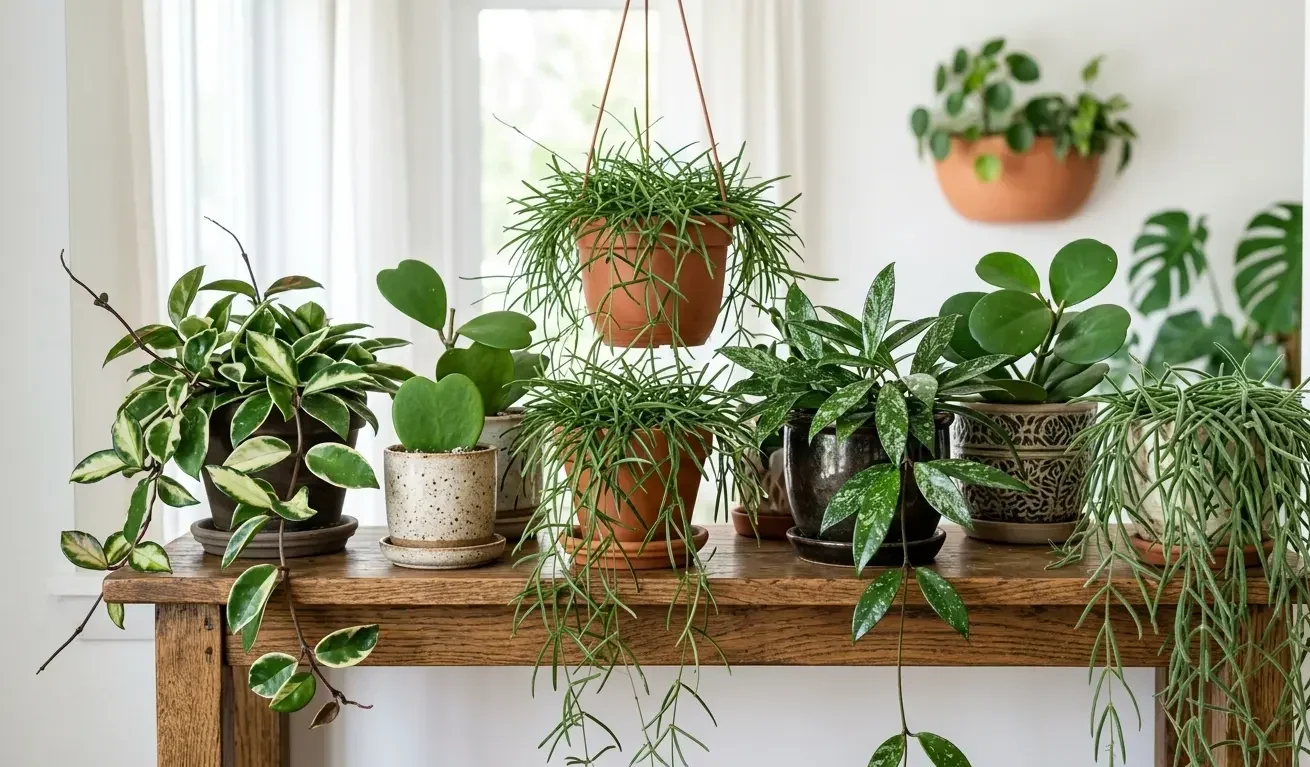
Hoyas, also called wax plants, are some of the most rewarding houseplants a beginner can grow, and once you start it is hard to stop at one. After years of growing them, the thing I tell people first is that there is no single “Hoya” look: the genus has hundreds of species, from thick waxy trailers to heart-shaped novelties to soft needle-leaved curtains, and most of them want the same simple care. They are also pet-safe, which sets them apart from many popular foliage plants.
Short answer
For your first Hoya, start with a Carnosa, Pubicalyx, or Australis, the toughest and most forgiving. For a fun gift plant, the heart-leaved Kerrii is hard to beat. For something that cascades, try the trailing Curtisii or Linearis. The full list below is sorted from easiest to more particular, so you can find the right one for your space and experience.
I have sorted this list roughly from the easiest, most beginner-proof Hoyas to the slightly more particular ones, and for each I note what it looks like, how it grows, and who it suits. If you want the general care rules that apply across the whole genus, my Hoya care guide covers light, watering, and how to get them to bloom.
Why grow a Hoya?
A few things make Hoyas special among houseplants. Their thick, often succulent leaves store water, so they forgive the occasional missed watering far better than most foliage plants. Many of them produce clusters of star-shaped, often intensely fragrant flowers that look almost artificial, like little wax sculptures, which is where the “wax plant” name comes from. And importantly, Hoyas are considered non-toxic and pet-safe, so unlike philodendrons and many aroids, you can grow them in a home with cats and dogs without worry.
| Need | What most Hoyas want |
|---|---|
| Light | Bright indirect light |
| Water | When the soil has dried out most of the way |
| Soil | Very airy, fast draining, almost like an orchid mix |
| Humidity | Average is fine, a little more is appreciated |
| Temperature | 18 to 27 degrees Celsius |
| Flowers | Need bright light and a mature plant to bloom |
| Toxicity | Non-toxic and pet-safe |
Quick picks at a glance
If you just want a fast answer, here are the standouts:
- Best for beginners: Hoya carnosa
- Toughest and fastest: Hoya pubicalyx
- Best gift plant: Hoya kerrii (Sweetheart)
- Best for hanging baskets: Hoya linearis
- Most unusual foliage: Hoya compacta (Hindu Rope)
- Best variegated: Hoya Krimson Queen
The 10 best Hoya varieties
1. Hoya carnosa
Quick take: The classic wax plant and the ideal first Hoya, with thick glossy leaves, fragrant flowers, and a very forgiving nature.
Hoya carnosa is the most common and popular Hoya, and the one I always recommend to start with. It has long vines of thick, waxy, oval leaves, sometimes flecked with silver, and produces clusters of fragrant pink and white star-shaped flowers once mature. It is genuinely easy: it adapts to bright indirect light or a slightly shadier spot, stores water in its leaves, and asks very little. If you can keep one Hoya alive while you learn, make it this one.

2. Hoya pubicalyx
Quick take: A fast-growing, almost indestructible Hoya with silver-flecked leaves, ideal for anyone who wants quick results.
Pubicalyx is one of the toughest and fastest Hoyas, which makes it a fantastic beginner plant. It has long, pointed, dark green leaves splashed with silvery specks, and it grows vigorously, so you see progress quickly. It blooms readily in good light with clusters of dusky pink to near-black fragrant flowers. If Carnosa is the safe classic, Pubicalyx is the one that grows fast enough to feel rewarding right away.
[ IMAGE NEEDED: hoya-pubicalyx.jpg ] PROMPT (Nano Banana): A Hoya pubicalyx with long pointed dark green leaves covered in silvery flecks, trailing vines. Photorealistic, single potted houseplant, clean neutral indoor background, soft natural light, high detail, no text, no watermark, sharp focus on the foliage. File name: hoya-pubicalyx.jpg Alt text: Hoya pubicalyx with dark green silver-flecked leaves Title: Hoya pubicalyx Caption: Pubicalyx is fast, tough, and silver-speckled. (Generate, save under the file name above, then delete this block before publishing)
3. Hoya australis
Quick take: A vigorous, fragrant climber with round glossy leaves that tolerates a range of conditions.
Hoya australis is another excellent beginner choice, with broad, round to oval glossy green leaves, often flushed reddish on new growth. Its vines can grow long, and it produces fragrant white flowers with red centers, usually in the cooler months. It is fast, adaptable, and a little more tolerant of lower light than some, which makes it a reliable, rewarding grower.

4. Hoya bella
Quick take: A compact, miniature wax plant with delicate leaves and profuse white flowers, perfect for small spaces.
Hoya bella, the Miniature Wax Plant, stays small and bushy rather than long and trailing, which makes it ideal for a shelf or a small hanging pot. It has dainty, lance-shaped green leaves and blooms generously with small, fragrant white flowers that have a purple center. It is a little more delicate than the tough Carnosa types and likes steady warmth and a bit more humidity, but it rewards you with one of the prettiest displays in the genus.

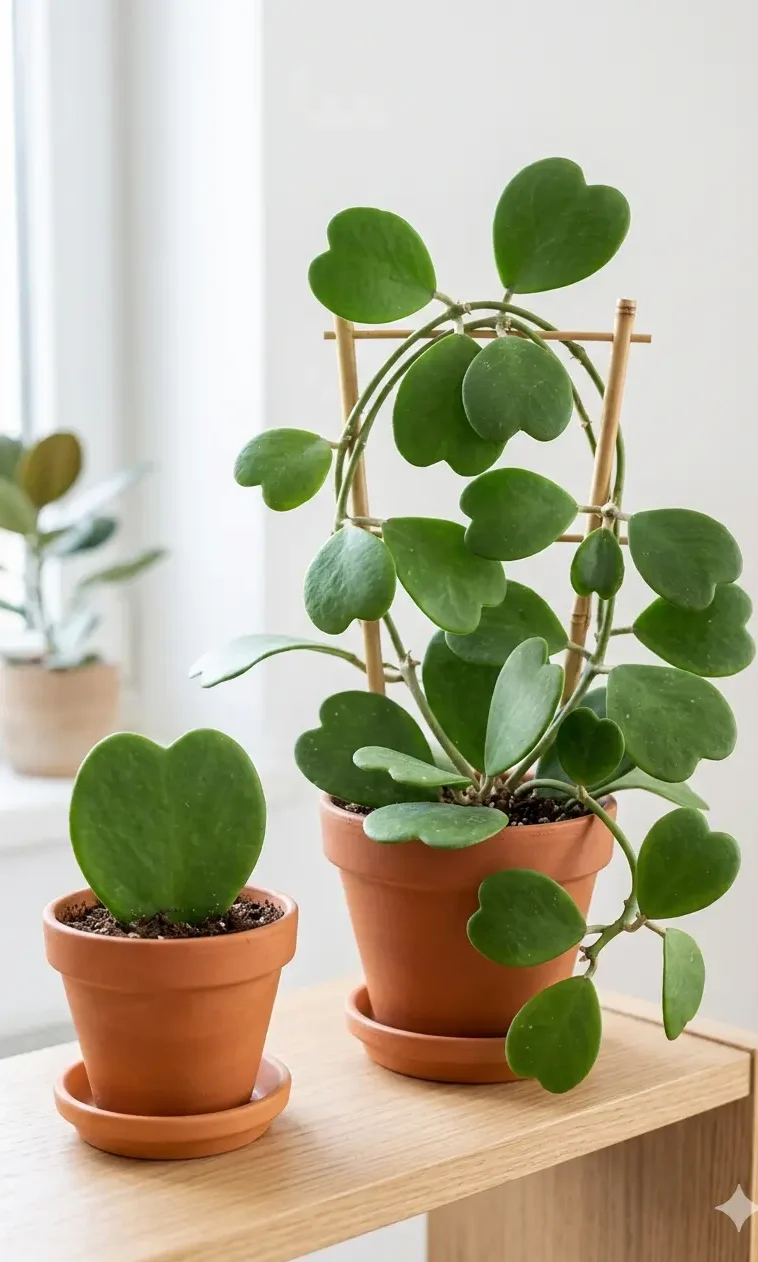
5. Hoya kerrii (Sweetheart Hoya)
Quick take: The famous heart-leaf Hoya, often sold as a single leaf, charming as a gift and a slow but rewarding full plant.
Hoya kerrii is the one everyone recognizes: its thick, succulent leaves are shaped like perfect hearts, which is why it sells by the truckload around Valentine’s Day, usually as a single rooted leaf in a tiny pot. One honest note worth knowing: a single leaf with no stem section will usually stay a cute leaf forever and not grow into a vine. If you want a full plant, buy a kerrii with a rooted stem and at least a couple of leaves. Given that, it is a slow but very easy grower, available in solid green and cream-variegated forms.
6. Hoya obovata
Quick take: A fast, easy Hoya with big round succulent leaves often speckled in silver, a great all-rounder.
Hoya obovata has large, round, thick green leaves frequently dotted with silver flecks and sometimes a pink or white blush. It grows quickly for a Hoya and is genuinely easy, which makes it a popular early collector plant. One useful thing to know: the silver speckling is just a natural light response, so do not pay a premium for an “Obovata Splash,” it is the same plant. It blooms with ball-shaped clusters of pale pink, red-centered flowers once mature.

7. Hoya carnosa ‘Krimson Queen’
Quick take: A beautifully variegated Carnosa cultivar with cream and pink edged leaves, as easy as the plain Carnosa.
Krimson Queen is a variegated form of the reliable Hoya carnosa, with thick leaves edged in creamy white that often flush pink, especially on new growth. You get all the toughness and easy care of the standard Carnosa with far more color. Like all variegated plants it wants good bright indirect light to keep its cream and pink sections strong, but otherwise it is just as forgiving as its green parent. (Its sister cultivar, Krimson Princess, has the variegation in the center of the leaf instead of the edges.)

8. Hoya carnosa ‘Compacta’ (Hindu Rope)
Quick take: A novelty Carnosa with curled, twisted, rope-like foliage, slow but striking and very low maintenance.
The Hindu Rope is one of the most distinctive Hoyas, with thick leaves that curl and fold tightly along the stem so the whole vine looks like a braided rope. It is a Carnosa cultivar, so it shares the same easy, drought-tolerant care, just slower growing. Its dense, twisted foliage holds water well and dislikes being overwatered or repotted often. It is a fun, sculptural plant that needs almost no fuss, just bright light and patience.

9. Hoya curtisii
Quick take: A tiny-leaved trailing Hoya with silver-speckled heart-shaped leaves, perfect for small spaces and shelves.
Hoya curtisii is a miniature charmer, with small, spade or heart-shaped grey-green leaves dusted in silver, growing tightly along creeping, trailing stems. It cascades beautifully from a shelf or small hanging pot and stays compact, which makes it ideal for tight spaces. It is a slow grower and a little less drought-tolerant than the big waxy types because its leaves are smaller, so it likes to not dry out completely, but it is still an easy, rewarding plant.

10. Hoya linearis
Quick take: A dramatic trailing Hoya with soft, needle-like leaves that cascade like a green curtain, a little more demanding but stunning.
Hoya linearis is the most distinctive plant on this list and the most particular. Instead of thick waxy leaves, it has long, slender, soft, slightly fuzzy needle-like leaves that hang down in dense curtains, giving it a waterfall-like look unlike any other Hoya. Because those narrow leaves hold less water, it is more sensitive to drying out and prefers higher humidity and cooler conditions than the tough Carnosa types. It is the one beginner-adjacent Hoya I would call intermediate, but its cascading form is worth the extra attention.

How to choose the right Hoya for you
If you are buying your first Hoya, start with a Carnosa, Pubicalyx, or Australis. They are the toughest, most forgiving, and most widely available, and they teach you the watering and light rhythm that every other Hoya follows. The Obovata and Krimson Queen are nearly as easy if you want bigger leaves or some variegation.
For something with character, the heart-leaved Kerrii makes a charming gift, and the twisted Hindu Rope is a low-maintenance novelty. If you want a plant that cascades from a shelf, the tiny Curtisii is easy, while the dramatic needle-leaved Linearis is the one to graduate to once you have the basics down, since it is fussier about humidity and watering.
Whichever you choose, the core routine barely changes: bright indirect light, a very airy fast-draining mix, and watering only once the soil has dried out most of the way. Get that rhythm right and you can grow almost any Hoya, and you will likely find yourself collecting more.
New to these plants? My Hoya care guide walks through light, watering, soil, and the all-important question of how to get a Hoya to bloom, and it is the best next read before you bring one home.
Which Hoya are you thinking of starting with, an easy Carnosa or something more unusual like the Hindu Rope or Linearis? Tell me in the comments and I will help you decide.
Frequently asked questions
What is the easiest Hoya for beginners?
Hoya carnosa is the easiest and most widely available. Its thick, waxy leaves store water so it forgives missed waterings, and it adapts to a range of indoor light. Pubicalyx and australis are nearly as forgiving.
Are Hoyas toxic to cats and dogs?
No. Unlike philodendrons and many aroids, Hoyas are considered non-toxic and pet-safe, which makes them a great choice for homes with curious cats and dogs.
Which Hoya has heart-shaped leaves?
Hoya kerrii, the Sweetheart Hoya, has thick heart-shaped leaves and is often sold as a single rooted leaf around Valentine’s Day. Hoya curtisii also has small heart-shaped leaves.
Why won’t my Hoya flower?
Usually not enough light. Hoyas need bright indirect light to bloom, and many take a couple of years to mature before flowering. Do not cut off the old flower stalks, called peduncles, because they rebloom from the same spot.
How often should I water a Hoya?
Let the soil dry out most of the way, then water thoroughly. Hoyas store water in their succulent leaves, so they prefer to dry out between waterings and are far more often killed by overwatering than by neglect.
Do Hoyas need high humidity?
Most adapt to normal household humidity, though they appreciate a bit more. Thin-leaved types like Hoya linearis are the exception and need higher humidity to stop their narrow leaves drying out.
What is the difference between a Hoya and a philodendron?
They are unrelated. Hoyas are succulent-leaved wax plants grown largely for fragrant flowers and are pet-safe, while philodendrons are aroids grown for foliage and are toxic to pets. Their care overlaps but is not the same.
