

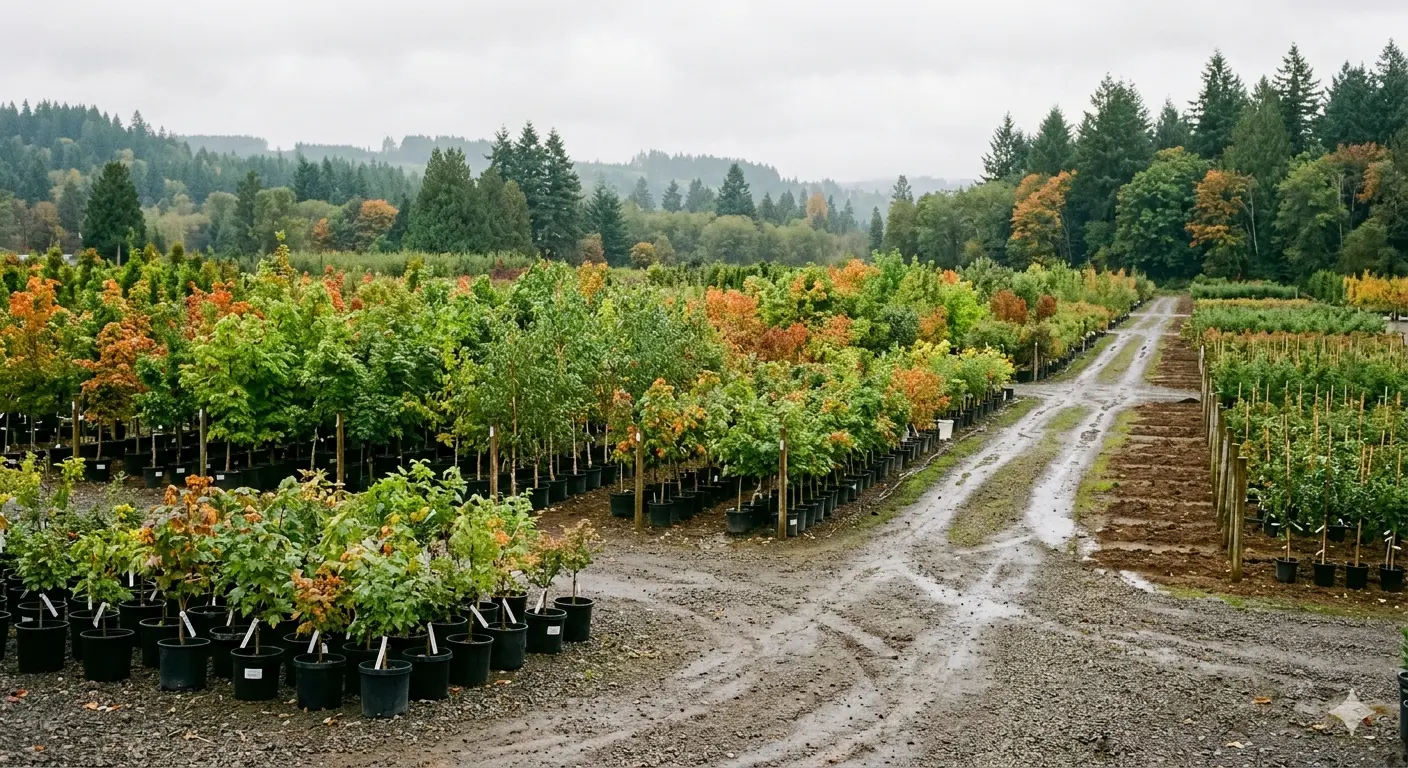
Heritage Seedlings in Salem, Oregon, is one of the most quietly important nurseries in North American horticulture. Founded in 1982 by Mark and Jolly Krautmann on five rented acres, the operation has grown over forty years into a leading wholesale propagator of rare deciduous trees and shrubs.
Their plants populate independent garden centers and landscape designs across the continent.
This article approaches Heritage Seedlings honestly. It is wholesale-only with a $750 minimum order, so the practical question for most home gardeners is not whether to visit but how to find their plants at retail. The picture below comes from their own materials, current public data, and industry references.
Quick answer
Heritage Seedlings and Liners in Salem, Oregon, is a wholesale-only propagator of rare deciduous trees and shrubs. Founded 1982 by Mark and Jolly Krautmann, now growing 520+ varieties. Specialties include Japanese Maples, Acer griseum, Stewartia, Cercidiphyllum, grafted Dogwoods, yellow Magnolias, and grafted Redbuds. Plus a native plant division for Pacific Northwest restoration. Home gardeners access their plants through retail nurseries.
What Heritage Seedlings actually is
A few things make Heritage genuinely distinctive in the wholesale nursery industry.
A 40-year propagation specialist. Heritage propagates from grafting, cuttings, and tissue culture. They are not a reseller of plants grown elsewhere. The plants are grown from the start, which produces the consistency and quality their retail-nursery customers count on.
Wholesale only with a $750 minimum order. This rules out home gardeners as direct customers. The minimum order signals serious trade-volume operation rather than a consumer-facing business.
More than 500 varieties. Their catalog runs to about 520 distinct kinds of rare and unusual woody plants. For garden centers wanting to differentiate from big-box selection, this depth is the draw.
A native-plant conservation arm. Heritage runs a parallel native-plant division growing more than 100 species for Willamette Valley habitat restoration. That is a real conservation commitment, not just a marketing line.
Founders still active. Mark and Jolly Krautmann started the operation in 1982 and have grown it across forty-plus years. That kind of founder continuity in a propagation nursery is increasingly rare.
What Heritage Seedlings actually grows
The catalog is built around several headline categories that the company itself emphasizes.
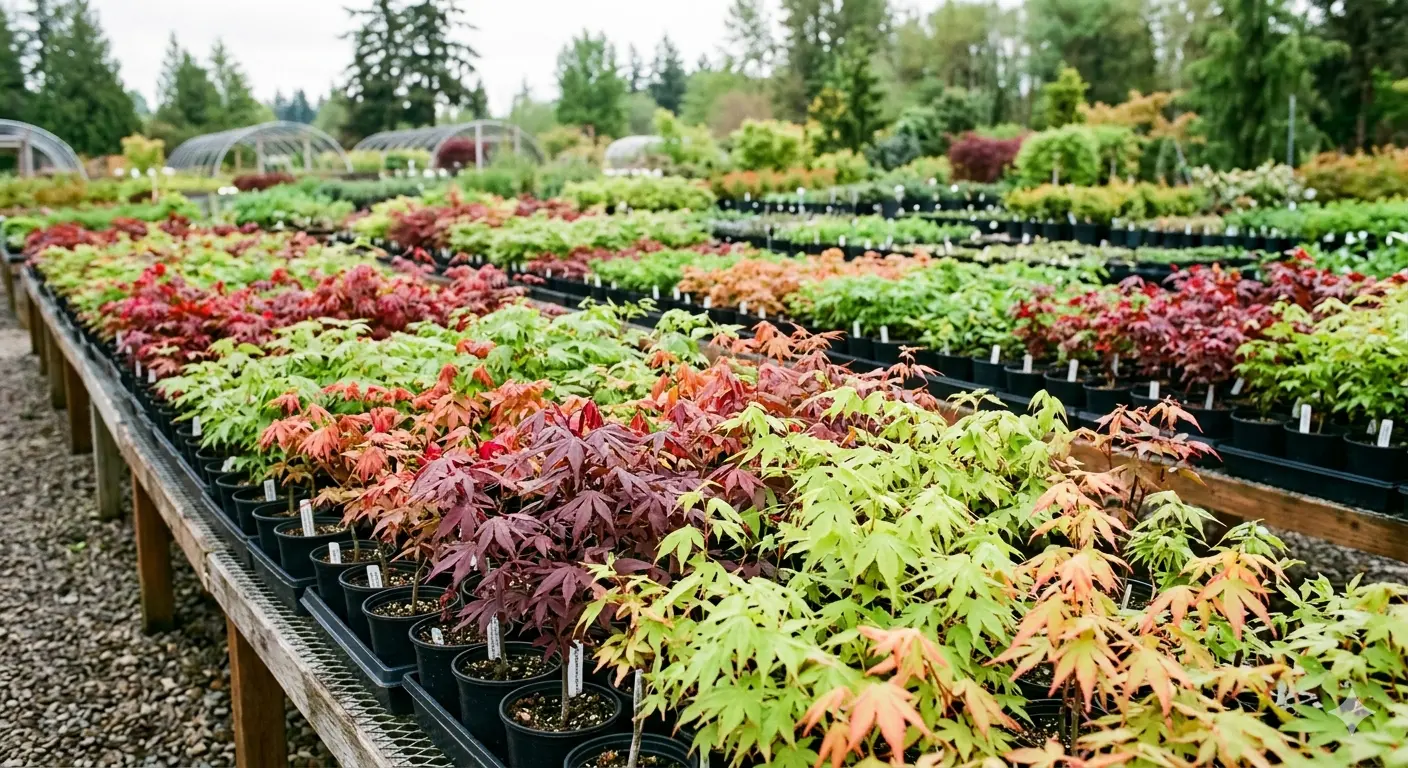
Japanese Maples. Both red and green forms have been staple items for more than 40 years. Heritage describes their Japanese Maples as grown with less irrigation than typical wholesale stock, which they argue reduces root disease and produces stronger plants.
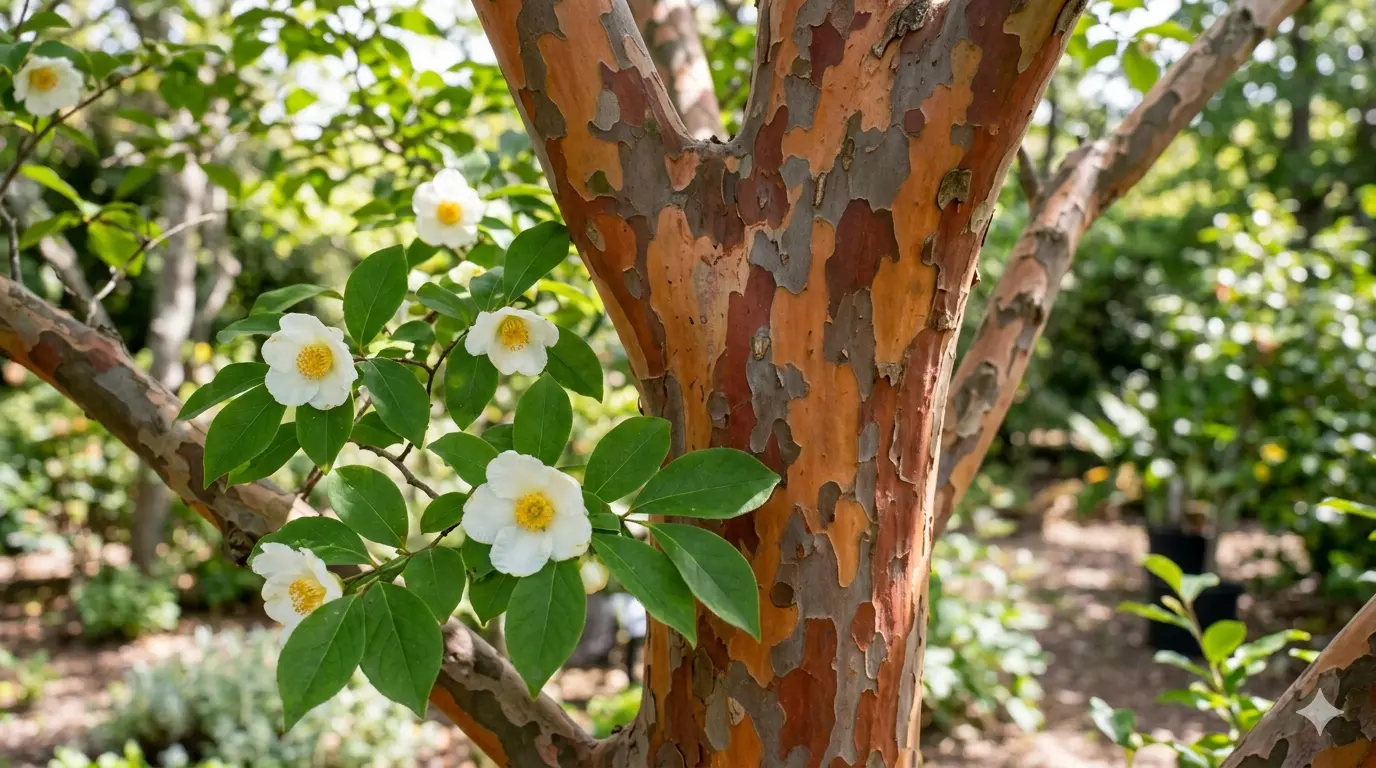
Acer griseum (Paperbark Maple). A rare and slow-growing tree prized for its cinnamon-brown peeling bark. Heritage is one of the better-known wholesale sources for this species, which has been difficult to propagate at scale historically.
Stewartia. The Heritage Seedlings story claims that without their propagation work, Japanese Stewartia would not be part of the fabric of the North American landscape today. That is a strong claim, but the company’s role in popularizing Stewartia in the trade is well documented.
Cercidiphyllum (Katsura tree). Another rare deciduous tree Heritage has helped popularize at the wholesale level.
Grafted Dogwoods, yellow Magnolias, grafted Redbuds. A specialty in propagating new and rare cultivars through grafting, which lets them produce plants that would be impossibly slow from seed.
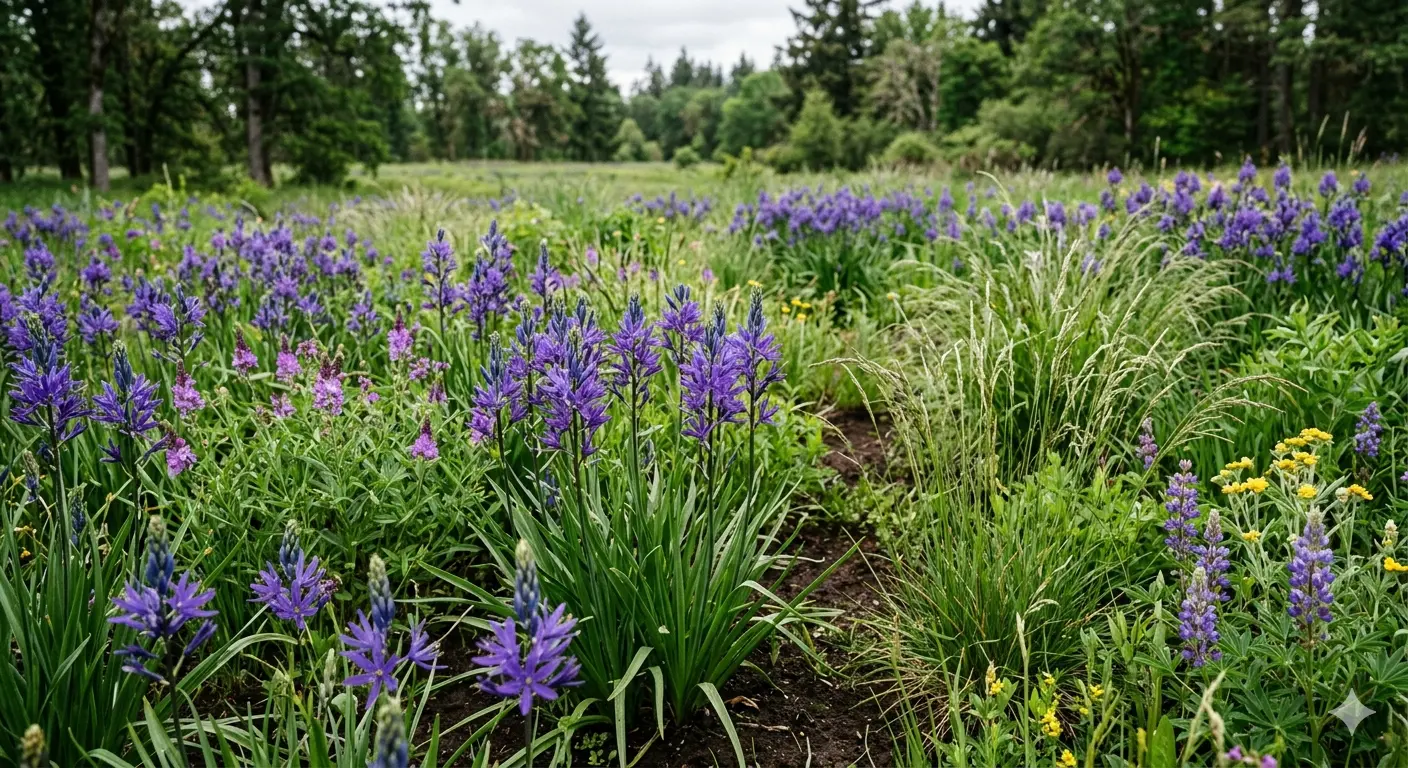
Native plants and wildflower seeds. A parallel division grows source-identified seed and plugs for over 100 species of Willamette Valley grasses, forbs, and riparian plants. These are used for habitat restoration, native landscape installation, and pollinator gardens.
How home gardeners can buy Heritage Seedlings plants
This is the practical question for most readers.
Ask independent garden centers about their suppliers. Heritage sells to garden centers and re-wholesale operations across the Pacific Northwest and beyond. If you find a rare Japanese Maple, Stewartia, or unusual Magnolia at a serious independent nursery, there is a real chance it started at Heritage. A direct question to your nursery’s manager will get you a useful answer.
Look for the specific cultivars Heritage propagates. Acer griseum, Cercidiphyllum japonicum, Stewartia pseudocamellia, and grafted dogwood or magnolia cultivars are all categories where Heritage stock is widely distributed. If your garden center carries these, the supply chain is often Heritage.
Pacific Northwest gardeners have the best access. Salem is in the heart of the Willamette Valley nursery region, and many Oregon-area garden centers source heavily from Heritage. For a curated selection of nursery options in this region, our best plant nurseries in Portland roundup covers retail destinations within a short drive of Heritage’s growing operations.
For native plant restoration projects, the native plant division accepts inquiries from larger projects directly. This is also wholesale, but the threshold conversation is different from the ornamental tree side.
What trade buyers and partners say
With only three Google reviews, the consumer-facing review sample is small. But the reviews come from the right kind of customer.
Long-term retail-nursery partners. One detailed review describes years of buying rare bareroot trees and shrubs from Heritage, with the staff repeatedly accommodating small custom requests that small retail nurseries depend on. That kind of partnership is not built on a single transaction.
Creative customer service is specifically named. Two of the three reviews use the phrase creative customer service, which is unusual language and suggests the operation actually problem-solves for partners rather than just processing orders.
Plant quality is consistently described as the best. The Google reviews use phrases like the most beautiful seedlings and the strongest in the market. For a wholesale propagator, this is the most important quality signal.
Industry standing. Beyond Google reviews, Heritage Seedlings is referenced positively across multiple horticulture industry publications and directories. Their work has been credited with introducing several Pacific Northwest native and unusual ornamental trees to wider commercial cultivation.
Where the experience has limits, honestly
A few things to set expectations clearly.
Wholesale only, no exceptions for casual buyers. The $750 minimum order is real and serves to keep the operation focused on its trade customers. Home gardeners cannot work around it.
Limited public reviews. Three reviews on Google is a small sample. Most of Heritage’s customer feedback flows through trade channels, industry publications, and direct partnerships rather than consumer-review platforms.
Pacific Northwest delivery is most economical. While Heritage ships nationally by UPS for smaller liners and by bulk truck for larger orders, the freight cost grows with distance. Closer-region wholesale buyers get the best value.
Wholesale-only website. The catalog and ordering systems are built for trade customers, not consumer browsing. Home gardeners browsing the site will see plant information but no consumer-friendly purchase path.
Why Heritage Seedlings matters even if you can’t shop there
For a home gardener, Heritage matters indirectly but meaningfully.
Your local independent nursery probably depends on operations like Heritage. The rare cultivars, the well-grown stock, the consistent quality that distinguishes a great independent from a so-so chain garden center, often trace back to a wholesale propagator like Heritage. Supporting independent nurseries supports the wholesale propagators that supply them.
Conservation work has wide impact. The Willamette Valley native-plant work supports habitat restoration that benefits the broader Pacific Northwest ecosystem. Even if you never personally buy a Heritage native plug, the restoration projects their nursery supports affect water quality, pollinators, and biodiversity across a region.
Acer griseum and Stewartia are easier to find now because of operations like Heritage. Forty years ago, propagating these species at scale was challenging. Today, you can find Acer griseum at decent independent garden centers across the country, and that availability is downstream of wholesale propagation work like Heritage’s.
How trade buyers can engage with Heritage Seedlings
For the subset of readers who are garden center owners, landscape designers, or wholesale plant buyers.
Start with the availability list on heritageseedlings.com. The current availability is published online and updated through the season. The catalog reflects the full range at season beginning.
Plan for the $750 minimum. Single-cultivar volume orders or mixed-cultivar consolidation both work. The minimum is by order, not by cultivar.
Consider the contract-grow option. Heritage will contract-grow large orders to specific genetics, hardiness, or size specifications. For landscape design projects with specific requirements, this is a real option that smaller wholesale buyers often overlook.
Pick up at the nursery, UPS, or bulk truck. Smaller liners ship economically by UPS. Larger transplants typically pick up or ship by bulk truck. Discuss the right option for your order size.
Email or call early in the season. Salem operations run year-round, but the bareroot pickup window is concentrated. February is mentioned by repeat customers as a key pickup month.
Confirm before driving
Heritage Seedlings is wholesale only with a $750 minimum order and no public retail access. Home gardeners cannot shop directly. The number to call for trade inquiries is (503) 585-9835. For home garden access to their cultivars, ask your local independent nursery whether they source from Heritage.
Final thoughts
Heritage Seedlings does much of the unglamorous wholesale work that makes great independent garden centers possible. Forty years of propagating rare deciduous trees, a serious commitment to native plant conservation, and the founder family still actively involved.
For home gardeners, the practical access route is through retail nurseries that source from them. For the trade, it is one of the better-known propagators in the Pacific Northwest.
If you have purchased a tree that started at Heritage Seedlings, knowingly or otherwise, I would love to hear about it in the comments. Real reader experiences with specific cultivars from Heritage stock help future plant shoppers know what to look for at their local nurseries.
Frequently Asked Questions
Where is Heritage Seedlings located?
Heritage Seedlings and Liners is at 4194 71st Avenue SE in Salem, Oregon 97317, in the Willamette Valley about 50 miles south of Portland. The location places it in one of the most active nursery regions in the United States.
Is Heritage Seedlings open to the public?
No. Heritage Seedlings is a wholesale-only propagator with a $750 minimum order. They sell to garden centers, landscape professionals, and other nurseries, not to walk-in consumers. Home gardeners can find their plants at the retail nurseries that buy from them.
What does Heritage Seedlings specialize in?
Rare and unusual deciduous trees and shrubs. The catalog runs to about 520 varieties, with specific strength in Japanese Maples, grafted Dogwoods, yellow Magnolias, grafted Redbuds, Acer griseum (Paperbark Maple), Cercidiphyllum, and Stewartia. They also grow Pacific Northwest native plants for restoration.
Who founded Heritage Seedlings?
Mark and Jolly Krautmann founded Heritage Seedlings in 1982 on 5 rented acres. Over the past 40+ years they have grown the operation to roughly 40 employees and more than 500 varieties of rare and unusual woody plants. The founding family remains involved.
How can home gardeners buy Heritage Seedlings plants?
Through retail garden centers and independent nurseries that source from Heritage. If you find a rare deciduous tree like a Japanese Maple, Stewartia, Acer griseum, or unusual Magnolia at an independent nursery, there is a real chance it started at Heritage. Ask your local garden center about their suppliers.
What plant sizes does Heritage Seedlings sell?
Sizes range from small greenhouse-propagated plugs and bare-root liners around 6 inches tall, up to 5-foot transplants suitable for size 2 to size 7 containers. Smaller liners ship easily by UPS. Larger transplants typically pick up at the nursery or ship by bulk truck.
