

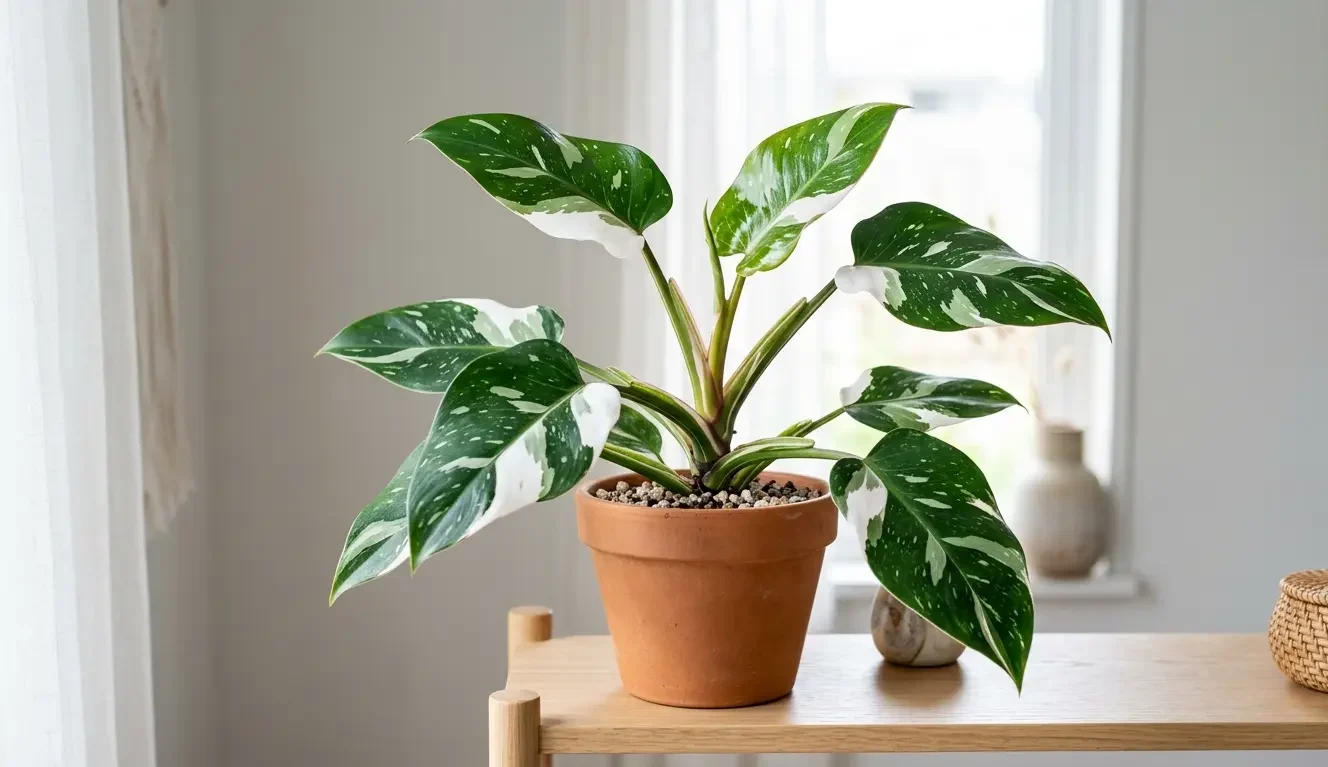
The Philodendron White Princess is one of the most sought after variegated philodendrons, prized for its green leaves splashed with crisp white. White Princess care is not complicated, but it does ask for a little more attention than a plain green philodendron, because that beautiful white variegation needs the right light to stay strong. Get the light and watering right and this is a striking, rewarding plant to grow.
Short answer
Give a Philodendron White Princess bright indirect light, water when the top inch or two of soil dries, and use a loose airy aroid mix. The white parts of the leaf cannot feed the plant, so strong light is what keeps the variegation coming in. Too little light is the main reason a White Princess turns mostly green.
This guide covers light, watering, soil, humidity, feeding, propagation, the variegation question everyone asks, and how to tell a White Princess from the very similar White Knight. The White Princess follows the same core rules as the rest of the group, so if you want the wider picture my philodendron care guide covers the basics that apply here too.
What is a Philodendron White Princess?
The White Princess is a variegated philodendron with green leaves marked by patches and splashes of white. It is closely related to the Pink Princess, and that family resemblance shows: a White Princess will sometimes throw a little pink alongside its white, which is completely normal and varies from leaf to leaf. Its leaves are relatively narrow and pointed, especially when young, becoming a touch more rounded as the plant matures.
It is part of what collectors call the white variegated trio, along with the White Knight and White Wizard. They look alike enough that they are constantly mislabeled in the trade, so it is worth knowing what you actually have. I will come back to how to tell them apart further down, because it is the question I get asked most about this plant.
Quick care summary
Here is the whole routine at a glance before the detail.
| Need | What the White Princess wants |
|---|---|
| Light | Bright indirect light, no harsh direct sun |
| Water | When the top inch or two of soil is dry |
| Soil | Loose, airy, well draining aroid mix |
| Humidity | Average to high, 50 percent or more is ideal |
| Temperature | 18 to 27 degrees Celsius, 65 to 80 Fahrenheit |
| Feeding | Balanced fertilizer monthly in spring and summer |
| Difficulty | Intermediate, mainly because of the variegation |
| Toxicity | Toxic to cats and dogs if eaten |
How much light does a White Princess need?
Light matters more for the White Princess than for almost any care factor, because it controls the variegation that makes the plant worth growing.
The White Princess wants bright indirect light. A spot near an east window, or a few feet back from a brighter south or west window, is ideal. The brighter the indirect light, the more reliably new leaves come in with strong white variegation. What you must avoid is long hours of harsh direct sun, because the pure white sections have no chlorophyll to protect them and scorch easily.
Here is the part people get wrong: the white parts of the leaf cannot photosynthesize. They are passengers, fed by the green parts. In a dim spot the plant simply cannot afford them, so it produces greener and greener leaves to survive. If your White Princess is slowly losing its white, the fix is almost always more light, not fertilizer.
Keeping the variegation strong
If new leaves are coming in greener, give the plant more bright indirect light before changing anything else. With variegated philodendrons, light is the lever that controls how much white you get.

How often should you water a White Princess?
Watering a White Princess follows the usual philodendron rule, with one extra reason to be careful: a heavily variegated plant has less green tissue and recovers more slowly from stress, so overwatering hurts it more.
Water when the top inch or two of soil has dried out. Push a finger into the soil; if it is dry at that depth, water thoroughly until it drains from the bottom, then empty the saucer. If it still feels damp, wait. In warm, bright months this often works out to about once a week, but go by the soil rather than a schedule, because pot size, light, and season all change how fast it dries. In winter, when growth slows, let it dry out more between waterings.
The overwatering trap
Yellow leaves and constantly damp soil mean overwatering, not thirst. Because a variegated plant has less green tissue to draw on, it bounces back slowly, so it is better to err on the dry side. Let the soil dry properly before watering again.

The best soil for a White Princess
As an aroid, the White Princess wants a loose, airy mix that drains fast and lets air reach the roots. Dense, heavy soil that stays wet is the quickest route to the root rot that variegated plants are especially slow to recover from.
A simple mix that works well is about 2 parts potting soil, 1 part orchid bark, and 1 part perlite. The bark and perlite open the mix up so water drains freely and air can reach the roots. Always use a pot with drainage holes, and pot up only one size at a time, since an oversized pot holds a large volume of wet soil that stays soggy around the roots.
Humidity and temperature for a White Princess
The White Princess is comfortable in normal home conditions but, like most variegated philodendrons, looks its best with a little extra humidity.
Keep it in normal room warmth, roughly 18 to 27 degrees Celsius (65 to 80 Fahrenheit), away from cold drafts and the dry air of heating vents. For humidity, average household air is usually fine, but around 50 percent or higher supports fuller, healthier growth and helps the delicate white sections hold up. A pebble tray or a small humidifier nearby works better than misting, which only raises humidity briefly and can leave spots on the leaves.
How to fertilize a White Princess
The White Princess is not a heavy feeder, and a light feeding routine during the growing season is plenty.
Feed with a balanced houseplant fertilizer about once a month through spring and summer, diluted to half the strength on the label. Stop feeding in autumn and winter when growth slows. A common mistake is to feed a struggling, mostly green plant hoping to bring back variegation, but fertilizer does not create white, light does, and overfeeding just risks burning the roots and browning the leaf tips.
How to propagate a White Princess
The White Princess is propagated by stem cuttings, with one important rule that is specific to variegated plants.
Take a cutting with at least one node, the small bump where roots and leaves form, and make sure the cutting includes some green tissue, not just white. A cutting that is all white has no way to feed itself and will not survive. Cut just below a node with clean scissors, place the cutting in water or moist sphagnum moss in bright indirect light, and refresh the water every few days. Roots usually appear within a few weeks, and once they are an inch or two long you can pot the cutting up in your usual aroid mix.

White Princess vs White Knight: how to tell them apart
This is the question I get asked most, because the White Princess and White Knight look almost identical at a glance and sellers mix them up constantly.

The reliable answer is to look at the stem, not the leaves. Leaf variegation varies so much from plant to plant that it tells you very little, but stem color stays consistent. The White Princess has green stems, sometimes tinged with pink or white. The White Knight has dark burgundy or wine colored stems. If you see that deep wine stem, it is a White Knight; if the stem is green, it is a White Princess. There is also a third plant in the group, the White Wizard, which has green stems with white striping and larger, rounder leaves.
A couple of softer clues back this up. White Princess leaves tend to be narrower and more pointed, while the White Knight’s are a little rounder, and the White Princess is the one that may show occasional pink, like its Pink Princess relative. But if you remember one thing, make it the stem color.
Common White Princess problems and how to fix them
Most White Princess problems come down to light, water, or the demands of the variegation itself.
Why is my White Princess losing its variegation?
Greener new leaves mean the plant is not getting enough light to support its white sections. Move it to a brighter spot with strong indirect light, out of harsh direct sun, and new growth should come in with more white.
Why does my White Princess have brown, crispy white patches?
The pure white sections have no chlorophyll and are the most fragile part of the leaf, so they brown first. This usually means too much direct sun, underwatering, or low humidity. Move it out of direct sun, water more consistently, and raise the humidity.
Why are my White Princess leaves turning yellow?
Yellowing, especially with damp soil, usually means overwatering. Let the soil dry out and ease off the watering. Because a variegated plant has less green tissue to recover with, it is worth being extra careful not to keep the soil soggy.
Why is my White Princess growing slowly?
Slow growth is normal for this plant, especially compared to plain green philodendrons, because it has less green tissue to power growth. Bright light, warmth, and feeding in the growing season will give you the fastest growth it is capable of, but it will never race like a Heartleaf.
A note on toxicity
Like other philodendrons, the White Princess is toxic to pets if eaten. It contains calcium oxalate crystals, which can cause mouth irritation, drooling, and stomach upset in cats and dogs that chew the leaves. The ASPCA lists philodendron as toxic to both cats and dogs, so keep your White Princess out of reach of curious pets.
Is the White Princess worth it?
For a grower who already has the basics down and wants a variegated showpiece, yes. The White Princess is not difficult in the way a fussy calathea is; it just asks you to pay attention to light to keep its best feature. If you are still finding your watering rhythm, it is worth starting with an easier philodendron first. My roundup of the best philodendron varieties for indoor growers shows where the White Princess sits among the easier and rarer types, so you can choose the right one for your experience level.
Are you trying to keep the variegation strong, or trying to tell your plant apart from a White Knight? Leave a comment below and I will help you sort it out.
Frequently asked questions
How do I tell a White Princess from a White Knight?
Check the stem, not the leaves. The White Princess has green stems, sometimes tinged pink or white, while the White Knight has dark burgundy or wine colored stems. Stem color is the most reliable difference because leaf variegation varies on both.
Why is my White Princess losing its white variegation?
Almost always too little light. The white sections cannot photosynthesize, so in a dim spot the plant favors green growth. Move it to brighter indirect light and new leaves should come in with more variegation.
Is the White Princess hard to care for?
It is intermediate. The care itself is simple, bright indirect light, careful watering, an airy mix, but holding the variegation takes more attention to light than an all green philodendron needs.
Can a White Princess have pink variegation?
Yes. As a close relative of the Pink Princess, the White Princess sometimes shows patches of pink alongside its white, which is normal and varies leaf to leaf.
How often should I water a White Princess?
Water when the top inch or two of soil is dry, usually about weekly in warm months and less in winter. The heavily variegated leaves make it sensitive to overwatering, so always check the soil first.
Why does my White Princess have brown or crispy white patches?
Pure white leaf sections have no chlorophyll to protect them, so they scorch easily in direct sun and brown first when the plant is stressed or underwatered. Keep it in bright indirect light and water consistently.
Is the White Princess toxic to pets?
Yes. Like other philodendrons it contains calcium oxalate crystals and is toxic to cats and dogs if chewed or eaten, so keep it out of their reach.
Should I cut off all white leaves on my White Princess?
A fully white leaf cannot feed the plant and will eventually die back, but you do not need to rush to remove it. Focus instead on keeping a healthy balance of green and white by giving the plant strong light.
