


No houseplant genus paints quite like Calathea. These tropical beauties are grown purely for their leaves, which come marked in stripes, spots, feathered rings, and mosaic networks, in greens, silvers, pinks, and deep purples. For pattern lovers, they are hard to beat.
They have a reputation for being a little dramatic about humidity, which is fair, but the foliage rewards the effort. This guide covers nine of the best Calathea varieties, sorted from the more forgiving to the pickier, with a quick guide to telling the similar ones apart.
Short answer
For your first Calathea, choose a more forgiving variety like the Rattlesnake, Network, or Orbifolia. For maximum pattern drama, the Pinstripe (pink stripes), Medallion (feathered rings), and Peacock are stunning but pickier. All Calatheas want high humidity and good water quality, and all are pet-safe.
A quick, reassuring note before we start: every Calathea on this list is non-toxic to cats and dogs, which makes them a favorite for pet homes. For the full care routine, my Calathea care guide covers humidity, watering, and the crispy-edge problem in depth.
How to tell Calatheas apart
Calatheas confuse people because so many have similar pattern styles. The fastest way to narrow it down is leaf shape first, then pattern family.
Start with shape. Some Calatheas have long, narrow leaves (Rattlesnake, Pinstripe), others broad ovals (Medallion, Peacock), and a few large round leaves (Orbifolia). Then look at the pattern: thin pinstripes, broad brushstroke bands, feathered concentric rings, or a fine mosaic network.
| Pattern family | Looks like | Examples |
|---|---|---|
| Thin pinstripes | Fine parallel lines | Pinstripe, Beauty Star |
| Broad bands | Wide brushstroke stripes | Orbifolia, Zebra |
| Feathered rings | Concentric medallion pattern | Medallion, Dottie |
| Spots and waves | Wavy leaf, dark spots | Rattlesnake |
| Mosaic network | Fine crosshatched grid | Network (Musaica) |
One bit of useful background: many plants sold as Calathea have been reclassified botanically as Goeppertia, and the whole group is often called prayer plants because the leaves fold up at night. The houseplant trade still uses Calathea, so that is what we will use here.
The 9 best Calathea varieties
1. Rattlesnake Calathea (lancifolia)
Quick take: Wavy, spotted leaves with burgundy undersides, and one of the most forgiving Calatheas.
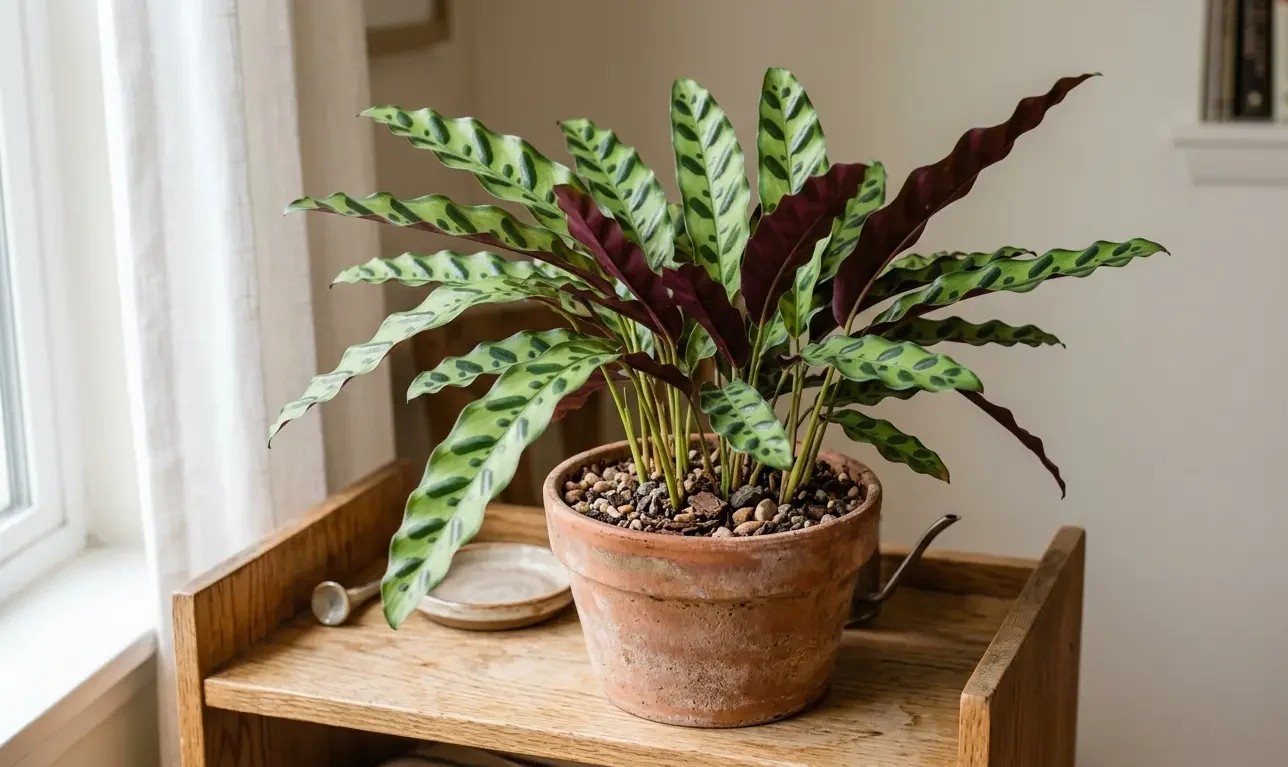
The Rattlesnake is a favorite first Calathea because it is among the easiest in a fussy genus. Its long, wavy, light-green leaves are marked with alternating dark-green spots that really do recall snakeskin, with rich burgundy undersides revealed as the leaves move.
It is dramatic and lush yet relatively tolerant, making it the variety I most often recommend to start with. It still wants humidity, but forgives a little more than its pickier cousins.
2. Calathea Orbifolia
Quick take: Large, round leaves with broad silver-green bands, bold and elegant.
Orbifolia is the showstopper of the group, with big, rounded leaves striped in alternating bands of silver and pale green that fan out beautifully. It grows large and brings an instant tropical, sophisticated feel to a room.
It is also relatively manageable for a Calathea, though its big leaves crisp quickly in dry air, so humidity matters. If you want one bold statement Calathea, this is often the one.

3. Network Calathea (musaica)
Quick take: A mesmerizing fine mosaic pattern, and one of the more forgiving types.
The Network Calathea, sometimes sold as musaica, is unlike any other in the genus: its leaves are covered in an intricate, fine, crosshatched grid of yellow-green, like tiny mosaic tiles. Up close, the geometric detail is hypnotic.
Happily, it is also one of the more forgiving Calatheas, with sturdier leaves than most. A great choice if you want something genuinely unusual that is not too temperamental.
4. Medallion Calathea (roseopicta)
Quick take: Broad round leaves with feathered concentric rings and deep purple undersides.
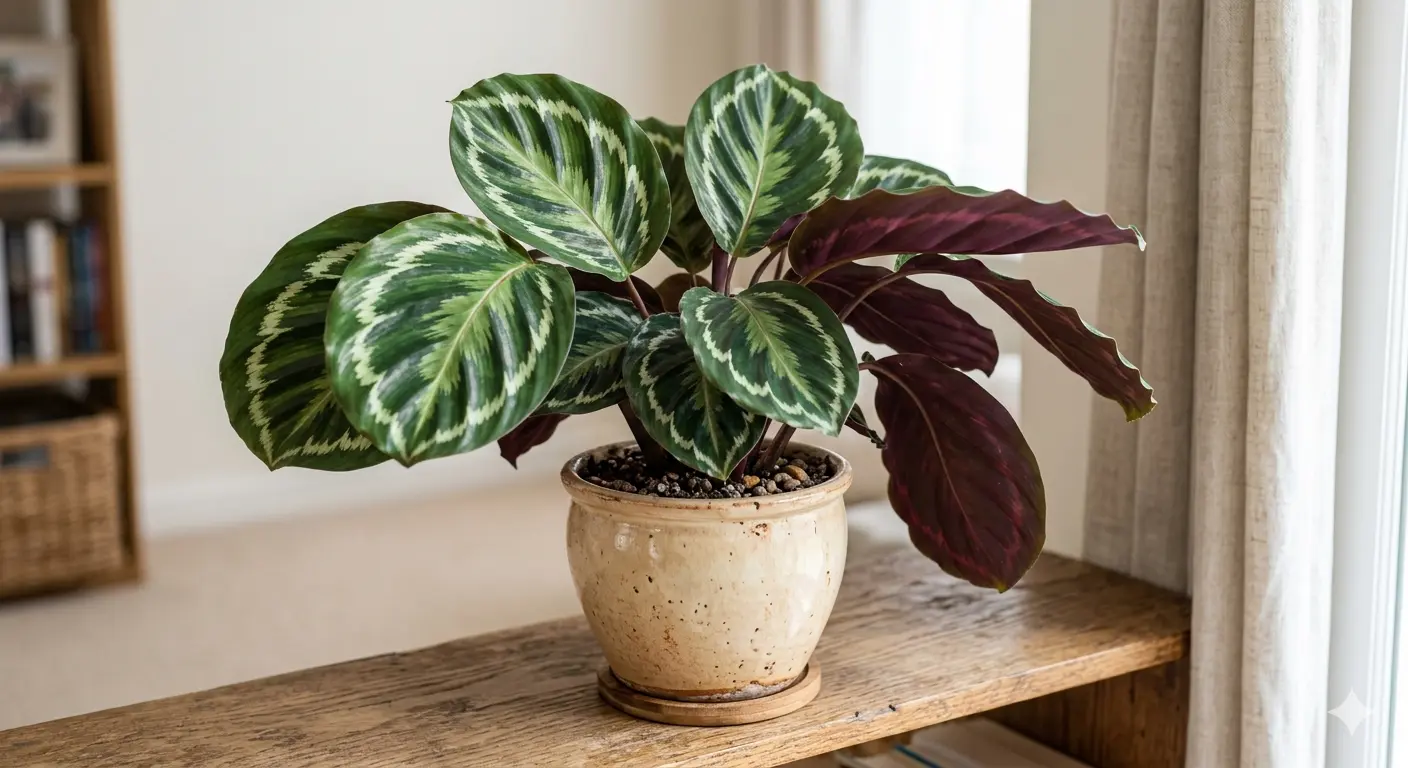
Medallion is one of the most popular Calatheas, and it is easy to see why. Its broad, rounded leaves carry a feathered, medallion-like pattern of dark green, lighter green, and creamy white radiating from the center, with striking deep-purple undersides.
It is moderately demanding, wanting consistent humidity and care, but the dramatic two-toned leaves are worth it. The purple-pink variation of this plant is sold as Dottie.
5. Zebra Calathea (zebrina)
Quick take: Soft, velvety leaves with bold zebra-like green bands.
The Zebra plant has some of the most touchable foliage in the genus: large, soft, velvety leaves in deep and light green, striped in a bold zebra pattern that radiates from the midrib. The texture alone makes it special.
It is moderately easy as Calatheas go, wanting the usual humidity and warmth. Its lush, velvety bands make it a quietly dramatic choice that stands out from the more line-patterned varieties.
6. Pinstripe Calathea (ornata)
Quick take: Dark leaves laced with fine pink stripes, elegant but a little fussy.
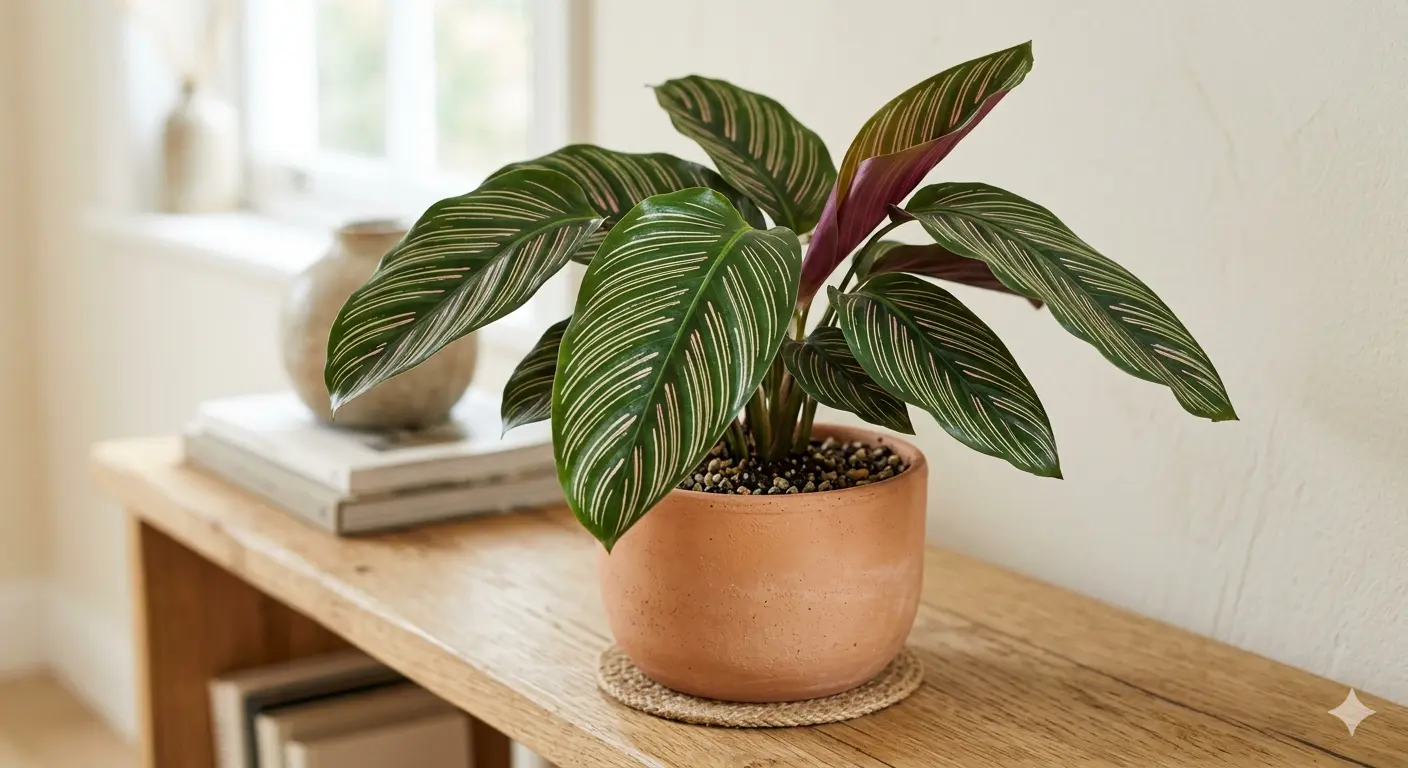
Pinstripe is one of the most elegant Calatheas, with long, dark-green leaves painted in thin, delicate pink-to-white stripes that run parallel to the veins, and maroon undersides. The effect is sophisticated and unmistakable.
It is among the pickier varieties, the fine stripes fade in too little light and the leaf edges crisp easily in dry air, so it rewards good humidity and bright indirect light. A beautiful step up once you have the basics down.
7. Beauty Star Calathea
Quick take: A flashier Pinstripe relative with neon-green and white radiating stripes.
Beauty Star is an ornata-type cultivar turned up to eleven, with longer, pointed leaves striped in vivid neon green and lighter white-to-pink lines radiating from the center, over deep purple-green undersides. The stripe color shifts with light.
It is similarly demanding to Pinstripe, wanting bright indirect light and high humidity to keep its colors sharp. Sellers sometimes lump it in with Pinstripe, but its bolder, brighter striping sets it apart.
8. Peacock Calathea (makoyana)
Quick take: Delicate cream-and-green feathered leaves, beautiful but demanding.
The Peacock plant earns its name with intricate, feather-like markings of cream and green over the leaf, with pink-to-maroon undersides, said to recall a peacock’s tail. It is one of the most beautiful and most coveted Calatheas.
It is also one of the trickier ones, sensitive to inconsistent watering, dry air, and change, so it suits a grower ready to dote a little. Consistent warmth and humidity are key to keeping it happy.
9. Rose-Painted Calathea (roseopicta types)
Quick take: A broad group of richly painted, pink-and-cream patterned roseopicta cultivars.
Beyond the classic Medallion, the rose-painted roseopicta group includes a range of gorgeous cultivars, like Rosy, Corona, and Dottie, with broad leaves washed in pink, cream, and green, often with a pink ring or rosy flush and purple undersides.
These are among the most colorful Calatheas, and care sits in the same moderate range, consistent humidity and bright indirect light. If you love pink-toned foliage, the roseopicta cultivars are the ones to explore.
How to choose the right Calathea
Decide between forgiving and flashy. If you are new to Calatheas or your home is on the dry side, start with a more tolerant variety, the Rattlesnake, Network, or Orbifolia, which handle average conditions better.
If you can provide steady humidity and want maximum pattern drama, the Pinstripe, Beauty Star, Medallion, Peacock, and roseopicta cultivars deliver the boldest color and detail. Just be ready to tend them a little more closely.
Whichever you choose, the core needs are the same: bright indirect light (never direct sun, which fades the patterns), evenly moist soil, warmth, and, above all, high humidity with good water quality. And the genus-wide bonus, all Calatheas are pet-safe.
New to these plants? My Calathea care guide walks through humidity, watering, the crispy-edge fix, and why water quality matters, and it is the best next read before you bring one home.
Which Calathea pattern has won you over, the bold Orbifolia, the pink Pinstripe, or the mosaic Network? Tell me in the comments and I will help you choose.
Frequently asked questions
What is the easiest Calathea variety for beginners?
The Rattlesnake (Calathea lancifolia), Network (musaica), and Orbifolia are among the most forgiving. Calatheas as a group are humidity-fussy, so none are truly beginner-proof, but these three handle average homes better than the picky Pinstripe or Peacock.
What is the prettiest Calathea?
It is subjective, but the Orbifolia (big silver-banded round leaves), Pinstripe (thin pink stripes), and Medallion (feathered concentric rings with purple undersides) are the most-loved for sheer pattern drama. The best one is whichever pattern you cannot stop looking at.
Why do Calatheas get crispy brown edges?
Almost always low humidity or water quality. Calatheas want high humidity and are sensitive to the minerals and chlorine in tap water, which brown the leaf edges. Use a humidifier and filtered, distilled, or rainwater to keep edges clean.
Are Calatheas and prayer plants the same thing?
They are closely related. Calatheas are often called prayer plants because they fold their leaves up at night, like true prayer plants (Maranta). Many Calatheas have also been reclassified botanically as Goeppertia, though the houseplant trade still calls them Calathea.
Are Calatheas toxic to pets?
No, and this is a big plus. Calatheas are non-toxic to cats and dogs, making them one of the best pet-safe ways to add bold, patterned foliage to a home.
Are Calatheas hard to care for?
They are moderate to demanding, mostly because of humidity. The care itself is consistent, bright indirect light, evenly moist soil, and warmth, but they need high humidity and good water quality, and they sulk over cold drafts and change. Rewarding, but a little fussy.
