


Few houseplants make a statement like an Alocasia. Often called elephant ears, these tropical aroids have some of the most dramatic foliage in the plant world, from velvety near-black leaves veined in white to silvery dragon-scale texture and bold zebra-striped stems.
Most Alocasias sold today are compact “Jewel” types prized for that striking foliage, though the genus also includes giant elephant ears that fill a corner. This guide covers the ten best for indoors, sorted from the most beginner-friendly to the more demanding collector types.
Short answer
For a first Alocasia, start with the popular ‘Polly’ (African Mask) or the zebra-stemmed Zebrina. For dramatic compact foliage, the Jewel Alocasias like Black Velvet, Dragon Scale, and Silver Dragon are stunning. For a big statement, elephant ears like Portora deliver. All need warmth, humidity, and bright indirect light.
If you want the full care routine that applies across the genus, my Alocasia care guide covers light, watering, humidity, the dormancy quirk, and spider mites in depth. Now, the varieties.
The two kinds of Alocasia
Before the list, one useful distinction. The Alocasias you will actually find in shops fall into two broad groups.
The Jewel Alocasias are the compact, collectible types, usually one to two feet tall, grown for dramatic, often metallic or velvety patterned leaves. Black Velvet, Dragon Scale, and Silver Dragon are jewels. These are what most people mean by “Alocasia” today.
The larger elephant ears are the big, architectural types that can reach several feet, grown as bold statement plants. Both groups share the same basic care, but the jewels stay shelf-sized while the elephant ears need floor space.
| Group | Grown for | Size |
|---|---|---|
| Jewel Alocasias | Dramatic compact foliage | 1 to 2 feet |
| Elephant ears | Bold architectural presence | 3 feet and up |
The 10 best Alocasia varieties
1. Alocasia ‘Polly’ (African Mask)
Quick take: The most popular and available Alocasia, and the best place to start.
Polly, also sold as African Mask or Amazonica, is the Alocasia most people meet first. It has glossy, dark-green, arrowhead-shaped leaves with wavy edges and bold white veins, staying compact at around 18 to 24 inches.
It is the most widely available variety and relatively forgiving by Alocasia standards, which makes it the natural first choice. Give it warmth, humidity, and bright indirect light and it makes a dramatic, sculptural houseplant.

2. Alocasia Zebrina
Quick take: Famous for its zebra-striped stems beneath large arrow-shaped leaves.
The Zebrina is unmistakable: its real showpiece is not the leaves but the petioles, the upright stalks, which are patterned with bold black and yellow zebra-like stripes. Atop them sit large, glossy, arrow-shaped leaves.
It grows to around three feet, making a striking statement, and is one of the more forgiving Alocasias. The dramatic striped stems give it a sculptural, almost animal-print look that few other houseplants can match.

3. Alocasia ‘Black Velvet’ (reginula)
Quick take: A compact jewel with velvety, near-black leaves and crisp white veins.
Black Velvet is one of the most beloved Jewel Alocasias, and a real contrast to the glossy types. Its small, rounded-heart leaves have a soft, velvety, almost black-green surface set off by striking silvery-white veins.
It stays very compact, often under a foot, which makes it perfect for a shelf or desk. Being a jewel type, it wants high humidity and careful watering, but the dramatic dark velvet foliage is worth the attention.

4. Alocasia ‘Dragon Scale’ (baginda)
Quick take: Textured, scale-like leaves with a striking 3D effect.
Dragon Scale is one of the most stunning jewel types, named for leaves that genuinely resemble reptilian scales. The silvery-green leaves have deeply sunken, contrasting dark veins that give each one a sculptural, three-dimensional texture.
It stays compact, usually two to three feet at most, with an upright habit. A favorite among collectors, it is a little more demanding on humidity, but few Alocasias have such an otherworldly, textured look.
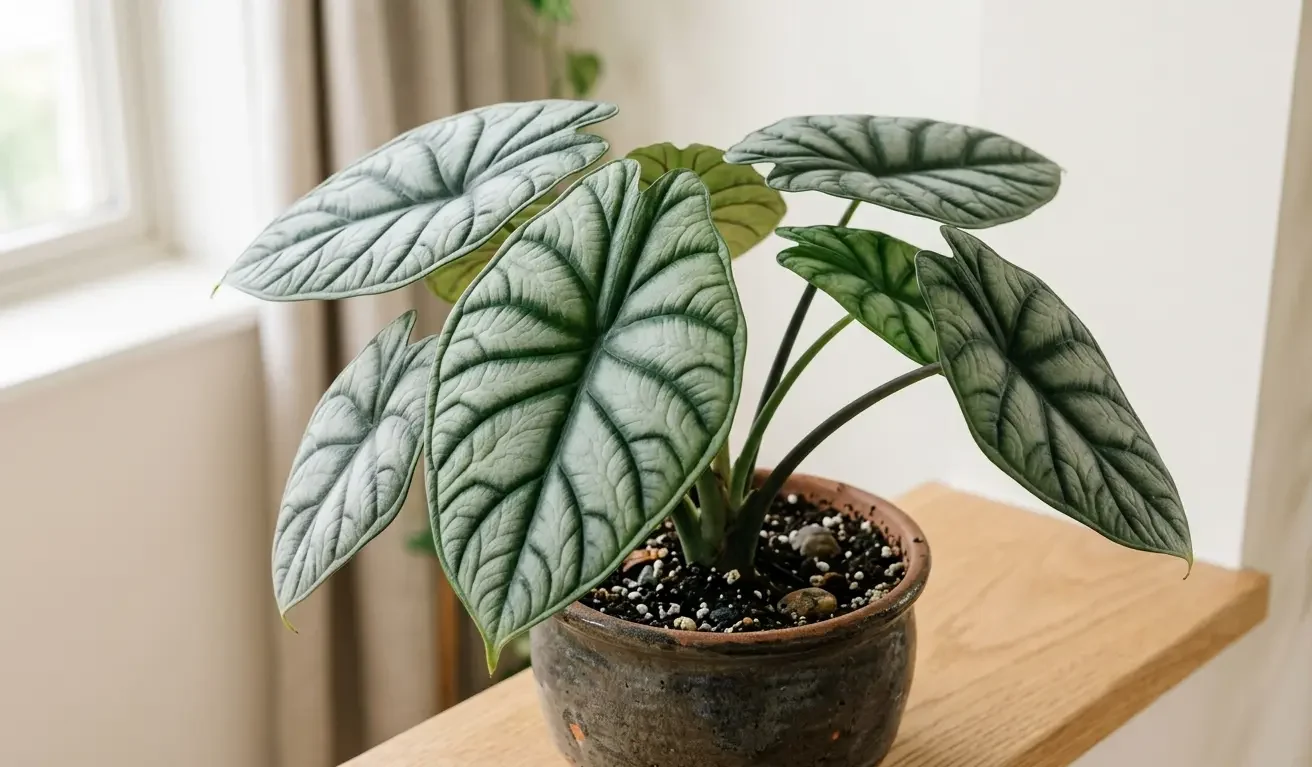
5. Alocasia ‘Silver Dragon’ (baginda)
Quick take: A close cousin of Dragon Scale with pale, silvery-blue leaves.
Silver Dragon shares Dragon Scale’s textured, veined leaves but in a paler palette: its foliage is a soft silvery-blue-green with sage-to-dark-green sunken veins, giving it a frosted, almost metallic glow.
It is compact, rarely topping three feet, with small leaves around six inches even when mature. If you love the dragon-scale texture but want something lighter and more silvery, this is the one.
6. Alocasia ‘Frydek’ (micholitziana)
Quick take: A velvety green jewel with bright white veins, like a green Black Velvet.
Frydek is the velvet-green counterpart to Black Velvet, with deep emerald, velvety, arrow-shaped leaves crossed by bold, bright white veins. There is also a sought-after variegated form for collectors.
It stays compact at around one to two feet and brings a lush, velvety texture. Like the other jewels it wants warmth and humidity, and rewards good care with dramatic, sculptural new leaves.
7. Alocasia cuprea ‘Red Secret’
Quick take: Metallic, coppery leaves with an almost iridescent sheen.
Cuprea, often sold as Red Secret, is unlike any other Alocasia, with thick, rounded leaves that shimmer in metallic coppery-red and bronze tones, deeply puckered around the veins. The undersides are a rich purple.
It is a compact jewel type, staying small, and a true collector’s showpiece for its metallic, almost reflective foliage. Bright indirect light brings out the best of its coppery sheen.
8. Alocasia ‘Stingray’
Quick take: A playful variety whose leaves really do look like a stingray.
Stingray is the most whimsical Alocasia, with leaves shaped exactly like its namesake: a broad, rippled “body” tapering to a long, narrow tail-like tip. It often has subtly striped stems like its Zebrina relative.
It grows larger than the jewels, making a fun, sculptural statement, and is a reliable conversation starter. A great pick if you want an Alocasia with real personality and movement.
9. Alocasia ‘Wentii’
Quick take: A tougher, larger jewel with bronze-green leaves and purple undersides.
Wentii, sometimes called the Hardy Elephant Ear, is one of the more robust Alocasias, with large, glossy, bronze-green leaves and striking deep-purple undersides. It bridges the jewel and elephant-ear groups.
It is more forgiving and vigorous than the delicate jewels, growing to a couple of feet, which makes it a good choice if you want Alocasia drama with a little more resilience.
10. Alocasia ‘Portora’ (and giant elephant ears)
Quick take: A big, architectural statement plant for filling a corner.
For sheer presence, the larger elephant ears deliver. Portora is a popular vigorous hybrid with large, glossy, deeply ruffled leaves on tall stems, reaching several feet and making a bold tropical statement in a bright room.
Other giants like Alocasia macrorrhiza and calidora grow even larger. These need floor space, warmth, humidity, and bright light, but nothing else gives a room quite the same jungle drama.
How to choose the right Alocasia
Start with size and space. If you want a shelf or tabletop plant, choose a compact Jewel Alocasia, Polly and Zebrina are the easiest, while Black Velvet, Dragon Scale, Silver Dragon, Frydek, and Cuprea offer the most dramatic foliage. If you want a floor-filling statement, go for an elephant ear like Portora.
Then be honest about care. All Alocasias want warmth, bright indirect light, and high humidity, and all dislike cold drafts and dry air. They are also prone to spider mites and often go dormant in winter, dropping leaves and regrowing later, which is normal, not death.
One note for pet owners: like the philodendrons and anthuriums, Alocasias are toxic to cats and dogs if chewed, so place them out of reach.
New to the genus? My Alocasia care guide walks through light, watering, humidity, dormancy, and pests, and it is the best next read before you bring one home.
Which Alocasia has caught your eye, the velvety Black Velvet, the striped Zebrina, or a big elephant ear? Tell me in the comments and I will help you choose.
Frequently asked questions
What is the best Alocasia for beginners?
Alocasia ‘Polly’ (African Mask) is the most popular and widely available, and a good first Alocasia. Zebrina is another relatively forgiving choice. All Alocasias are a bit fussy about humidity and watering, so they suit a gardener ready for a small challenge rather than a true beginner.
What are Jewel Alocasias?
Jewel Alocasias are the compact, collectible types prized for dramatic, often metallic or velvety foliage, like Black Velvet, Dragon Scale, and Silver Dragon. They stay small, usually one to two feet, which makes them popular houseplants, unlike the giant elephant-ear types.
Why is my Alocasia dropping all its leaves?
Often it is going dormant, not dying. Alocasias commonly drop leaves and rest in winter or after stress, then regrow from the tuber when conditions improve. Keep the soil barely moist and warm, and be patient. Sudden leaf loss can also signal overwatering or spider mites.
Are Alocasias hard to care for?
They are moderate. The care is consistent, bright indirect light, warmth, high humidity, and evenly moist but never soggy soil, but Alocasias dislike cold and dry air, are prone to spider mites, and may go dormant, which catches people off guard. Get the basics right and they are very rewarding.
Are Alocasias toxic to pets?
Yes. Like other aroids such as philodendrons and anthuriums, Alocasias contain calcium oxalate crystals and are toxic to cats and dogs if chewed, and the sap can irritate skin. Keep them out of reach of curious pets.
What is the difference between Alocasia and Colocasia?
Both are called elephant ears, but Alocasia leaves generally point up and outward, while Colocasia leaves point down. Alocasias are the types usually grown as houseplants, while many Colocasias are grown outdoors.
